Although the case for a September hike remains strong, sequentially softer inflation data lessens the likelihood of it being delivered. For that reason, we have increased our scenario probability of ‘Just right’ to 60%, which now becomes our base case, and have reduced the probability of our most hawkish ‘Too hot’ scenario.
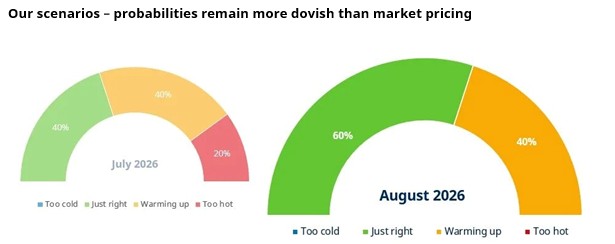
Source: Schroders Global Fixed Income team 14 August 2026 – Scenarios are framed around US Fed funds rates: Too Hot: +3 hikes, Warming up: +1-2 hikes, Just right: unchanged, Too cold: +1cut
Given our shift in probabilities, and with market pricing continuing to have a more hawkish skew than we do, we maintain our overweight score to global duration and upgrade the US to positive as we see less scope for underperformance here.
Events in the Middle East and the global energy outlook will remain key drivers, but valuations, in terms of outright global yields, are attractive.
Criticism of the last Fed meeting focussed on reduced forward guidance from new Fed chair Kevin Warsh. We disagree - we have no problem with reduced forward guidance. In fact, we endorse it. The quest for transparency often gives rise to information overload and false precision about inherently uncertain outcomes.
But we do believe that objectives must be explicit, even when reducing the level of guidance provided as to the tactics to achieve them. The last Federal Open Market Committee (FOMC) confused rather than clarified these objectives. Which measure of inflation is most important to judge underlying inflation? Over what time-horizon should inflation return to target? What level is acceptable – 2% exactly, or 2%-ish? Either answer is fine, ambiguity is not.
Greater clarity from the Fed chair would be welcome, sooner rather than later. Until then, however, we are taking a neutral view on the yield curve. A more proactive Fed with stronger inflation-fighting credibility is a necessary component for a curve-flattening view, and that has become more questionable for the time being.
Who does – and doesn’t – need hikes?
Within our positive overall score for global duration, we have shifted our geographical preferences, with Canadian bonds joining their US neighbours in being upgraded.
While the Canadian labour market has stabilised, with unemployment no longer rising, and growth being fine, the core inflation outlook is inconsistent with any policy change by the Bank of Canada (BoC). Yet, the market prices the BoC to tighten policy further than almost any major central bank in the next 12 months, which we believe is unlikely to be realised, creating a compelling opportunity in shorter-dated bonds.
In the UK, although core inflation dynamics have recently been very favourable, our concern is that inflation is likely to increase towards year-end. This means we are less positive on UK gilts but continue to believe the Bank of England is unlikely to deliver the hikes priced by the market.
We downgrade Japanese bonds on our view that the Bank of Japan will need to more aggressively tighten policy, given the inflation outlook and failure of currency intervention to turn the tide for the yen. Until it grasps the nettle, we believe Japanese government bonds remain vulnerable.
And finally …
On asset allocation, the major change is an upgrade to Eastern European sovereigns, which remain our top pick. Despite the excellent performance by Hungarian bonds year-to-date, we see further upside given the totemic shift in political outlook since Peter Magyar’s election victory. We believe the next catalyst for performance will be the new administration setting a path towards adoption of the euro currency. The criteria required for euro entry will require pragmatic economic and fiscal policy supportive of Hungarian bonds – both in hard (euro) and local currency.
Elsewhere, we observe rising political risks in both France and Italy ahead of elections in 2027, but believe current valuation levels compensate better for these risks in French rather than Italian government bonds, given that Italy now trades with lower yields than its neighbour. Quite the turnaround given Italy commanded nearly a 2% yield pick-up over France as recently as 2022.
Finally, across the board, we remain neutral on corporate credit. The story here is little changed: the macro backdrop is good; valuations are not.
|