Isio has published its latest analysis of the investment performance and asset allocation of 14 major UK DC master trust providers.
The latest quarterly update highlights how maintaining exposure to growth assets through periods of short-term volatility can support stronger long-term member outcomes.
Global equities rebounded strongly in Q2 2026 as geopolitical tensions eased and oil prices fell, improving investor sentiment. Emerging market equities outperformed developed counterparts, led by the technology-heavy markets of South Korea and Taiwan. UK equities underperformed the US and Europe, while credit markets delivered positive returns despite continued uncertainty around interest rates.
Providers maintain long-term focus through market volatility
Periods of short-term volatility remain an expected feature of long-term investing, particularly for growth-phase strategies with higher exposure to equities and other return-seeking assets.
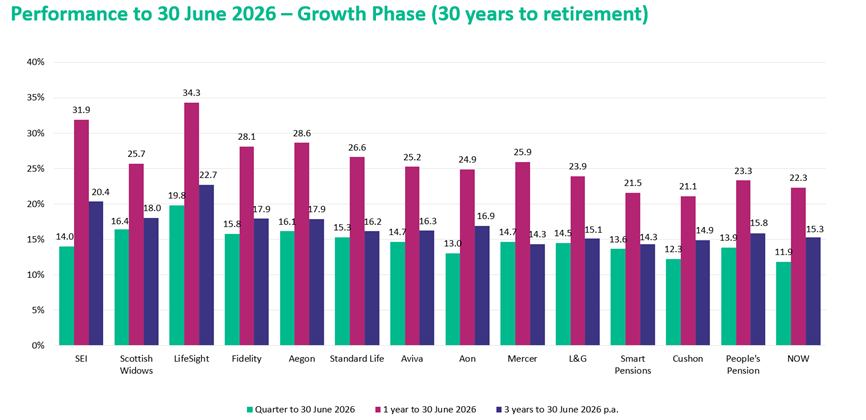
Following a challenging start to the year, all growth-phase strategies in Isio’s analysis delivered positive returns during Q2, ranging from 11.9% to 19.8%. This compared with a range of +0.9% to -4.5% in Q1 and demonstrated how quickly market conditions can change – and how difficult short-term movements can be to navigate successfully.
Longer-term outcomes remained significantly stronger, with one-year returns ranging from 21.1% to 34.3% and three-year annualised returns ranging from 14.3% p.a. to 22.7% p.a.
The variation in outcomes continues to highlight the importance of strategic design decisions within default strategies. While equity allocations remain a key driver of returns, regional and sector positioning can also produce meaningful differences between providers.
Providers are also gradually introducing private market exposures and broadening diversification. As allocations to private equity, real assets and private credit become more established, they have the potential to introduce additional sources of return and lead to greater differentiation between strategies over time.
Diversification supports positive outcomes at retirement
At-retirement strategies also delivered positive returns during Q2, ranging from 4.6% to 7.9%. One-year returns ranged from 8.9% to 16.4%, while three-year annualised returns ranged from 7.6% p.a. to 12.3% p.a.
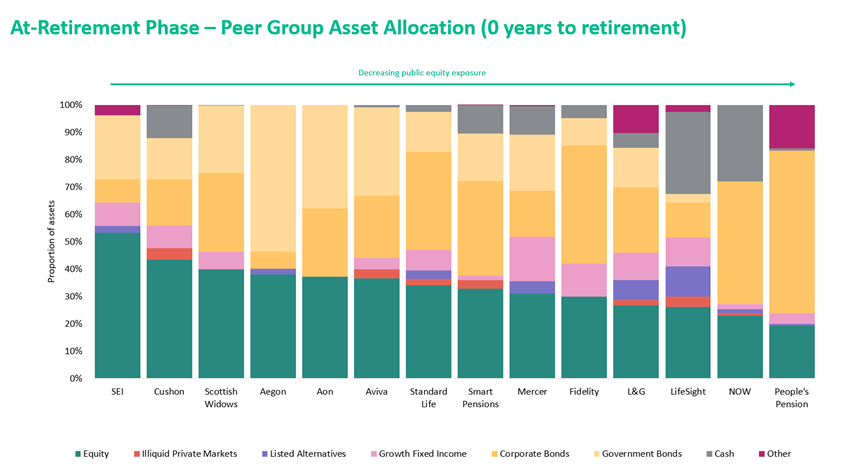
Importantly, performance was not determined solely by the level of equity exposure. Providers with lower equity allocations were still able to deliver competitive outcomes, reflecting differences in regional positioning, fixed income and alternative asset exposures, and overall portfolio construction.
This highlights that while asset allocation remains an important determinant of long-term returns, implementation decisions can also have a meaningful impact on member outcomes. As strategies become more diversified, performance differences are likely to be driven by a broader range of factors than equity allocation alone.
Recent discussions on pension adequacy have reinforced the importance of achieving sufficient investment growth throughout a member’s savings journey. Evidence supporting the Pensions Commission’s Interim Report indicates that net investment returns could account for around two-thirds of a final pension pot.
This becomes a more complex balancing act as members approach retirement. While reducing investment risk can help protect accumulated savings, doing so too early may limit the growth needed to deliver adequate retirement income.
Mark Powley, Head of DC Master Trust Research at Isio, said: “Q2 was a reminder of how quickly market conditions can change. Following a volatile start to the year, markets rebounded strongly and all of the growth-phase strategies in our analysis delivered positive quarterly returns.
“What’s notable is that providers have generally maintained a disciplined, long-term approach rather than reacting to short-term market movements. Members who remain invested are better positioned to participate when markets recover, while attempting to time those turning points remains extremely difficult.
“We also continue to see the importance of diversification at retirement. Equity exposure remains an important driver of returns, but it does not explain the full range of outcomes. Regional positioning, fixed income, alternatives and implementation decisions all matter as providers balance capital preservation with the need for continued growth.”
|