A scheme’s s179 liabilities represent, broadly speaking, the premium that would have to be paid to an insurance company to take on the payment of PPF levels of compensation. This compensation may be lower than full scheme benefits.
Highlights
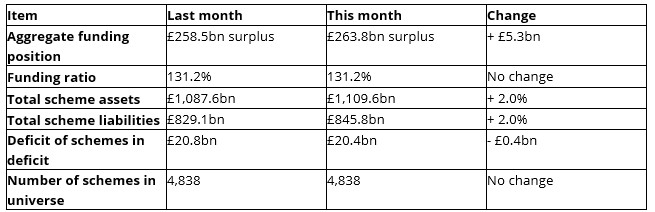
Shalin Bhagwan, PPF Chief Actuary, said: “During May, market sentiment continued to be shaped by the energy uncertainty from the conflict in the Middle East. Asset and liability values of the PPF-eligible DB universe increased over the month as bond yields eased slightly. Softer data releases and optimism on conflict resolution helped to bring down inflation expectations and reduced market confidence that central banks will tighten policy later in the year. At the same time, overseas equity markets continued to perform well, supported by resilient corporate earnings - particularly in the US - and ongoing investor optimism around AI-driven growth.
Against this backdrop, the PPF 7800 index recorded a £5.3bn increase in the estimated aggregate funding position, taking it to a surplus of £263.8bn. The funding ratio remained steady at 131.2 per cent, as both scheme asset and liability values rose by 2.0 per cent."
A note on changes to the PPF 7800 Index
In our December 2025 update, we highlighted that the government had announced that it would legislate to allow us to pay prospective indexation starting from 2027 for service accrued pre-1997 for members of schemes who provided this as a right. As well as schemes that have already transferred to the PPF, this will also impact the s179 liabilities of schemes in the PPF universe. In April the Pension Schemes Act received Royal Assent. As we’ve signposted, we’ll reflect the impact from these changes in the PPF 7800 Index in due course.
View the June update and see the supporting data on the 7800 Index for 31 May 2026 here: The PPF 7800 index | Pension Protection Fund.
|











