|
|





 |  |  |  |
One in six (16%) people have hesitated or refused a pay rise, bonus or promotion because they were concerned that higher taxes or lost allowances could reduce the financial benefit. Over a fifth (21%) would consider turning down a pay rise if it meant they’d have to pay a higher rate of income tax, while 7% say the same about losing other support or allowances. Five years after the tax threshold freeze was announced, analysis shows the Personal Allowance would be £16,072 in 2026/27 had it kept pace with inflation - £3,502 higher than its current level |
A pay rise should feel like progress, but new research from Standard Life, a retirement specialist focused entirely on retirement savings and income, finds that one in six (16%) have hesitated over or refused a pay rise, bonus or promotion because they were concerned they could lose out financially, including 5% who have turned an opportunity down altogether.
It’s now five years since the income tax threshold was frozen and rising wages are pushing more people into higher tax bands, affecting their eligibility for valuable support. This is shaping how some people feel about future progression. Over a fifth (21%) say paying a higher rate of income tax could make them consider turning down a pay rise, while 7% cite the risk of losing other financial support or allowances and 5% point to losing childcare support.
Younger workers and parents are more likely to think twice
Younger workers are particularly cautious. Over a quarter of Gen Z (28%) say they have hesitated over or refused a pay increase, compared with 19% of Millennials, 10% of Gen X and just 3% of Baby Boomers.
Parents with children under 18 are also more likely to have hesitated, at 22% compared with 14% of non-parents. Almost one in ten parents (9%) say losing childcare support could make them turn down a pay increase, versus 4% of non-parents, a figure that may reflect people considering the potential impact on future family plans.
Less than half know pensions could help
Pension contributions can reduce adjusted net income and may help some people manage the impact of key income thresholds, but the research found that awareness of this is low. Less than half (48%) correctly identify that increasing pension contributions can help reduce the amount of income tax some people pay, while 37% do not know and 15% believe this is false.
Once the potential benefit is explained, more than half (56%) say they would consider increasing their pension contributions if it helped them retain more of a pay rise or bonus, rising to 63% of Gen Z workers.
Five years of frozen thresholds
The potential role pensions can play has become more relevant as frozen tax thresholds have fallen behind inflation. Five years after the freeze was announced, Standard Life analysis shows that the Personal Allowance would stand at £16,072 in 2026/27 had it kept pace with inflation - £3,502 above its current level. The higher-rate threshold would be £64,274, rather than £50,270.
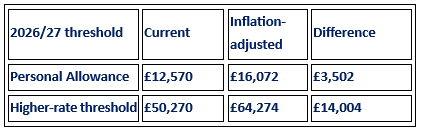 Based on this, the frozen Personal Allowance adds £700.36 to the annual income tax bill of a basic-rate taxpayer who uses the allowance in full. For someone earning above the inflation-adjusted higher-rate threshold, the combined impact of both frozen thresholds is £3,501.22.
For some people, increasing pension contributions could help manage this impact by reducing adjusted net income or extending the amount taxed at the basic rate, depending on how contributions are made. This could help them retain more of a pay rise or bonus while also boosting their retirement savings.
Neil Jones, Tax and Estate Planning Specialist at Standard Life plc, said: “A pay rise, promotion or bonus should be something to celebrate, so it’s concerning that some people are thinking twice because they’re worried they could end up worse off. It’s understandable that people want to protect valuable allowances and manage how much tax they pay, but turning down additional income without fully understanding your options could mean missing out unnecessarily.
“The findings also highlight a knowledge gap around pensions, with less than half aware that increasing contributions can help reduce the amount of income tax some people pay. For those approaching certain income thresholds, paying more into a pension may, depending on their circumstances, help reduce the tax impact while also putting more aside for retirement.
“With changes to salary sacrifice due from April 2029, one of the tools some employees currently use to increase pension saving and improve tax efficiency could become less effective. That may reduce the options available to help offset the impact of a pay rise or bonus through pension contributions, making it even more important that people understand the options available before deciding whether turning down additional income is the right choice for them.”
Neil’s top tips if a pay rise has pushed you into higher-rate tax band in the 2026/27 tax year:
1. Understand how pension salary sacrifice works
“If your employer offers salary sacrifice, increasing pension contributions can reduce your taxable income while putting more into your pension. This can be particularly useful if a pay rise takes you into a higher tax band or across another important income threshold. You may also pay less National Insurance than if you took the additional salary as cash, although the rules around salary sacrifice are due to change from April 2029.”
2. Check you’re getting the pension tax relief you’re entitled to
“Pension contributions benefit from tax relief, and this can become more valuable as your tax rate rises. Basic-rate taxpayers effectively receive 20% tax relief, while higher and additional-rate taxpayers can qualify for relief at 40% and 45%. Depending on how contributions are made, the additional relief may need to be claimed from HMRC, so it’s worth checking you’re receiving what you’re entitled to.”
3. Keep an eye on your Personal Savings Allowance
“Moving into a higher tax band can also change how much interest you can earn on savings before paying tax. The Personal Savings Allowance is £1,000 for basic-rate taxpayers, falling to £500 for higher-rate taxpayers, while additional-rate taxpayers don’t receive an allowance. If a pay rise moves you into a new band, it’s worth checking what that could mean for any cash savings you hold.”
4. Check what a higher income means for family support
“For parents, rising income can affect valuable support. The High Income Child Benefit Charge starts when the higher earner’s adjusted net income exceeds £60,000, with Child Benefit fully clawed back at £80,000. There’s another important threshold at £100,000, when eligibility for Tax-Free Childcare can be lost. Pension contributions can reduce adjusted net income, so it’s worth understanding how these thresholds interact if your earnings are increasing.”
5. Watch out for the £100,000 threshold
"If your income exceeds £100,000, you start to lose your Personal Allowance, meaning more of your earnings become taxable. This can result in a surprisingly high tax bill on additional income, including pay rises or bonuses. Pension contributions can reduce your adjusted net income and may help some people preserve more of their Personal Allowance."
6. Don’t forget Marriage Allowance
“Marriage Allowance, worth up to £252 a year, is another benefit that can be lost if either partner becomes a higher-rate taxpayer. A pay rise, bonus or overtime payment could be enough to affect eligibility, so checking your wider financial position when your income changes can help avoid any surprises.”
7. Consider tax on your investments
"The tax impact of frozen thresholds doesn't stop with your salary. In some cases, reducing your taxable income through pension contributions may mean you pay a lower rate of tax on investment gains, making it worth considering how different parts of your finances work together."
|
|
|
|
| Pricing Actuary | ||
| London - £180,000 Per Annum | ||
| Actuary - Financial Planning & Analysis | ||
| London/Hybrid - Negotiable | ||
| Capital Actuary | ||
| London/Hybrid - £100,000 Per Annum | ||
| Reserving Actuary | ||
| London - £120,000 Per Annum | ||
| Pricing Actuary, Marine Cargo/Property | ||
| London - £130,000 to £150,000 Per Annum | ||
| Pricing Actuary – Cyber | ||
| London - £120,000 Per Annum | ||
| Reinsurance Pricing Actuary, Analytics | ||
| London - £130,000 to £180,000 Per Annum | ||
| Reinsurance Pricing Actuary | ||
| London - £140,000 Per Annum | ||
| Head of Capital | ||
| London - £170,000 Per Annum | ||
| ART Pricing | ||
| London - £100,000 Per Annum | ||
| Pricing Transformation Actuary | ||
| London - £130,000 Per Annum | ||
| Pricing Actuary | ||
| London - £80,000 to £120,000 Per Annum | ||
| Pensions on Divorce Startup - Flexibl... | ||
| Remote - Negotiable | ||
| SVP, Head of Reserve Forecast Analytics | ||
| Bermuda - £200,000 Per Annum | ||
| START-UP, Lead Reinsurance Actuary | ||
| London - Negotiable | ||
| Senior Actuary | ||
| London - Negotiable | ||
| Reserving Manager | ||
| London - £130,000 Per Annum | ||
| Senior Reserving Consultant | ||
| London - £100,000 Per Annum | ||
| Head of Capital | ||
| London - £180,000 Per Annum | ||
| Head of Portfolio Optimisation | ||
| London - Negotiable | ||




Be the first to contribute to our definitive actuarial reference forum. Built by actuaries for actuaries.
Copyright © 2026 Actuarial Post. Created by Zero-One Design Ltd