‘It’s still not magic: Framing the risks facing financial services in the Gen AI era’ builds on its 2019 predecessor report. As part of the research, we surveyed senior financial services practitioners and observers and found that:
70% agreed ‘risks arising from the use of AI are among the greatest risks facing my sector over the next five years’.75% agreed ‘the risks posed by AI to my sector have increased substantially since generative AI technologies have become widely available'.The top three risks highlighted were cyber threats, misleading outputs, and knowledge gaps.
Generative AI has fundamentally changed the risk landscape not only because it can ‘hallucinate’, or present false or misleading information that appears authoritative. It also makes AI widely accessible, persuasive, easy to use and embedded in every day financial workflows. As firms increasingly build AI into tools and infrastructure, many of the most complex risks are ecosystem risks. Decisions that appear sensible for individual firms can create hidden dependencies and shared points of failure across the financial system.
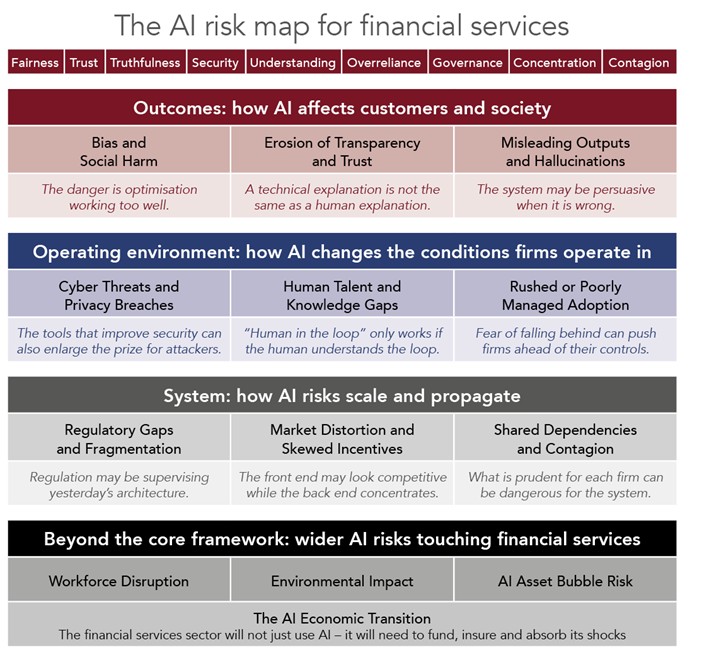
The report’s AI risk framework identifies nine risks which are grouped into three broad categories: ‘outcomes’, ‘operating environment’ and ‘system’. These provide a useful way to trace how AI risk moves through the financial services ecosystem: from the outcomes experienced by customers and society, to the environment in which firms deploy AI, to the system-level dynamics through which risks can scale and spread.
The framework treats AI risks as trade-offs, rather than standalone downsides. Often, the risks are the direct counterpart of AI’s benefits – sharper prediction, deeper personalisation, greater scale and complexity, and more autonomous decision-making. Although risks cannot be eliminated altogether, the framework outlines how many can be moderated through better risk management, governance, and regulation.
Keyur Patel, LFBF Research Associate and report author, said: “The same characteristics that make AI useful in financial services also create many of the risks that make it so difficult to govern. The hard question, then, is not just whether these risks can be mitigated, but how much risk we are willing to live with in exchange for the benefits. That is why a recurring theme in this report is ‘uncomfortable tensions’: the same machinery can widen inclusion and sharpen exclusion; ‘human in the loop’ is not the same as human control; and concentration is baked into how AI systems are built. Generative AI gives these tensions new force. It lowers barriers to use, makes AI feel relatable and trustworthy, and is increasingly embedded in how financial institutions think and work. That matters because AI outputs can be useful, confident and wrong at the same time – and ‘mostly right’ can be dangerous.”
Paul Sweeting FIA C.Act, IFoA President, said: “AI is a defining force of our time. The IFoA’s Artificial Intelligence and Emerging Technologies Practice Board is exploring how transformative technologies are reshaping actuarial practice and influencing broader societal systems. It is also exploring what we need to do to seize the opportunities and manage the risks associated with AI-adoption. With our unique combination of technical skill, communication and professional oversight, actuaries must play a key role making sure that AI is working as it should.”
|





.jpg)







(2).jpg)