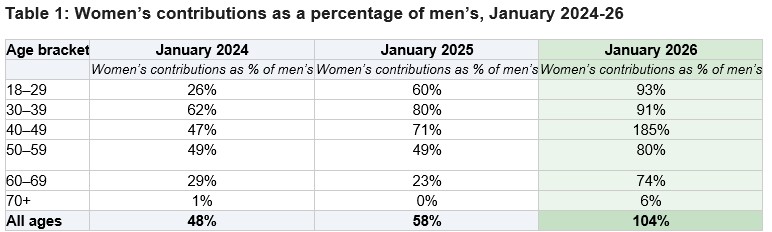
The milestone follows consistent year-on-year increases in contributions each January. Back in 2024, women contributed less than half of men’s total, this rose to just under 60% in 2025, with women’s pension contributions now surpassing men’s for the first time since 2018.
Women in their forties drive the uplift
The age split reveals that women aged 40 to 49 contributed 85% more than men in the same age group during January 2026, driving much of the overall increase. The surge in pension contributions coincides with HMRC’s 31 January Self-Assessment tax deadline, reflecting recent data from the Office for National Statistics (ONS) showing the number of women in self-employment in the last quarter of 2025 at the highest recorded since mid-2020. The data suggests that self-employed and freelance women in their 40s are making significant last-minute lump sum contributions to bolster their pension savings and make the most of pensions tax relief.
Maike Currie, VP Personal Finance at PensionBee, commented: “Seeing women out-contribute men - for the crucial self-assessment month of January - is very encouraging, showing more women in their forties are in self-employment and/or are higher rate tax payers and conscious of the importance of making pension contributions. This matters as ONS data also shows that earnings peak at about age 44 for women, after which income growth tends to flatten and eventually decline. However, across other age groups the picture is still very uneven, despite improvements on previous years. Women aged 18 to 29 contributed 7% less than men, while those aged 60 to 69 contributed 26% less, a gap that reflects a lifetime of compounding disadvantage rather than disengagement.”
Progress within a persistent gap
Recent years have seen a positive trend in female saving, with women contributing 58% the amount of men in 2025, up from 48% in 2024. However, to put the January 2026 contribution milestone in context - the last time PensionBee female clients contributed more than their male counterparts was in April 2018, prior to the Covid-19 pandemic.
After that, women contributed less than men for each successive year, up until this January, reflecting the so-called ‘pandemic penalty’. While no-one was spared the far-reaching physical and financial impacts of the pandemic, women were more likely to work in those industries that required face-to-face interaction - retail, hospitality, travel, airlines, self-care and education - which suffered more during these years and consequently impacted financial resilience. Many women experienced a fall in income or left the workforce to care for children and/or sick or elderly relatives, which impacted both earnings and pension contributions.
PensionBee’s research found that every year spent out of the workforce for unpaid care reduces a pension pot by roughly £5,000 at retirement, while switching to part-time work reduces it by £2,000.
Despite the positive trend, when it comes to the contributions of those women in their 40s, the wider gender backdrop remains stark. Pensions Policy Institute (PPI) data shows that for men aged 45 to 49, the median pension pot at £138,816 is more than twice that of women at £67,975. This substantial gender pension gap is largely due to the financial penalties of motherhood and caregiving, referred to as the ‘motherhood’ and ‘good daughter’ penalty, respectively.
Maike Currie commented: “In January 2024, women contributed less than half as much as men; last year that gap narrowed significantly; and this year, women overtook men altogether.
“There is clearly growing engagement and a determination from women in their mid-forties in particular to bolster their retirement savings. However, closing the gender pension gap will require systemic reform. Women remain overrepresented among the UK’s ‘invisible workers’ - falling outside the net of Auto-Enrolment, which has very much been designed around formal employment structures and the payroll.
“PensionBee’s Invisible Worker campaign, is calling on the Government to expand Auto-Enrolment by removing the £10,000 earnings trigger and enabling the self-employed to save through their Self-Assessment tax returns. These changes will help tackle structural inequalities like the gender pension gap.”
Table 1: Women’s contributions as a percentage of men’s, January 2024-26
Source: PensionBee data, January 2026
|











