Michael Field, chief equity strategist at Morningstar, noted: “Popularity for AI funds has hit record highs. However, with recent valuations flatlining or even declining, opportunities have opened for investors in the space. Currently, AI is trading at its largest discount since 2019, making now a fantastic entry point. So, what does this tell us? AI isn’t a bubble that’s going to burst anytime soon – the underlying fundamentals are robust. Demand for semiconductors is beating expectations and key drivers like data centres and infrastructure remain intact. The AI story has further to go, and investors should make the most of it while these opportunities still exist.”
Key findings include:
The volatility experienced in early 2026 led to a decline from record-high valuations among AI stocks, resulting in more attractive pricing for those most impacted, presenting a current buy opportunity.
The strongest opportunities sit in infrastructure “picks-and-shovels” players.
Many widely held names in AI portfolios - including Apple - have limited direct AI exposure, while lesser-known companies, such as Entegris and CGI (held by fewer than 2% of AI-focused fund managers) are largely ignored despite strong links to the AI value chain.
Private AI companies have significantly outperformed public markets peers since late 2024.AI funds remain concentrated in US mega-cap tech. Beyond names such as ASML and SAP, European names do not feature strongly.
Beyond the US, China is a significant hub for AI development. Due to access and regulatory challenges, most European managers avoid Chinese equities or focus only on major companies like Baidu and Alibaba, leaving smaller, more innovative players largely inaccessible. Chinese AI stocks (as measured by the CSI Artificial Intelligence Index) have underperformed their developed-market counterparts since 2022, suggesting that investors have not sacrificed returns by avoiding the region.
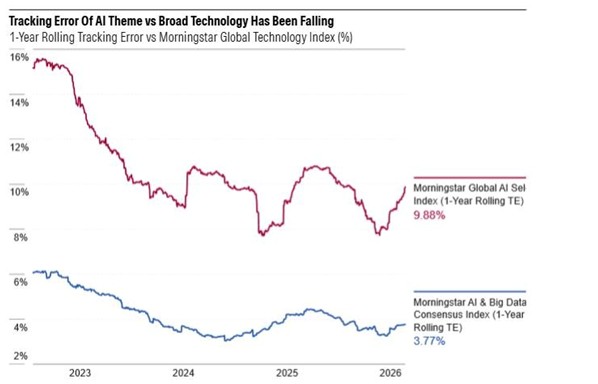 Kenneth Lamont, Principal at Morningstar, explained: “We’re seeing record inflows into AI funds in Europe, with assets near all-time highs – but implementation has been everything. During February’s ‘SaaSpocalypse’, two prominent AI funds’ performance diverged by 14 percentage points. To help investors navigate this complex backdrop, we’ve developed a scoring framework that distinguishes funds with strong revenue exposure to core AI from those tilted toward more peripheral ‘AI adopters’. On that basis, the First Trust Artificial Intelligence ETF ranks highest for core AI exposure and stands out as a compelling way to access the theme while valuations remain attractive. But AI is also becoming a victim of its own success. As AI leaders have come to dominate the tech sector, overlap with broad technology indices has more than doubled since 2019 - raising the bar for active differentiation and putting pressure on providers to justify their premium.”
|