More than a third of pension savers are ‘winging it’ when it comes to their retirement savings, as new analysis from Standard Life, a retirement specialist focused entirely on retirement savings and income, shows how taking a more active approach to retirement saving could make a £95,000 difference over a working lifetime.
With Pension Engagement Season underway, new Standard Life research, has identified three distinct pension personalities among UK non-retired Defined Contribution (DC) pension savers – Wingers, Planners and Late Bloomers – revealing very different approaches to preparing for retirement.
The personalities are based on how people describe their current approach to retirement saving. Wingers are more likely to leave their pension alone, put off thinking about retirement or feel unsure where to start. Planners take a more active approach, such as regularly reviewing their pension or looking for ways to improve their savings. Late Bloomers may have paid less attention to retirement in the past but are now beginning to take it more seriously.
Meet the Wingers – over a third (36%) of pension savers
The most common pension personality is the Winger, accounting for more than a third (36%) of pension savers surveyed. Wingers are particularly common among younger savers, with 45% of 18–34-year-olds falling into this category, compared with 35% of those aged 35–54 and 26% of over-55s. Women are also more likely than men to be Wingers (40% versus 33%).
Their hands-off approach is reflected in how closely they monitor their retirement savings. Almost one in five (18%) never review their pension, only 10% know exactly how much they have saved, and just over a fifth (22%) know exactly how much they personally contribute. Unsurprisingly, this lower engagement is accompanied by lower confidence, with only 26% feeling on track for the retirement they want.
Meet the Planners – over a quarter (29%) of pension savers
Over a quarter (29%) pension savers are Planners, taking a more active role in managing their retirement savings through regular reviews, checking progress and seeking opportunities to improve their outcomes. Men are more likely to be Planners than women (35% versus 23%), while the proportion changes little by age, ranging from 28% to 31% across generations. Planners are also particularly common among those with private or SIPP pensions, where 45% fall into this category.
Their higher engagement is evident in their understanding of their finances. Almost six in 10 (59%) regularly review their pension, more than a third (37%) know exactly how much they have saved and almost half (49%) know exactly how much they personally contribute. This stronger grasp of their retirement savings is reflected in confidence levels, with two thirds (67%) saying they feel on track for the retirement they want.
Meet the Late Bloomers – a quarter (25%) of pension savers
A quarter (25%) of pension savers are Late Bloomers – people who may have paid less attention to retirement saving in the past but are now becoming more engaged, often after a change in circumstances or a growing awareness of the need to plan ahead. They are most common among Gen X, with 30% of 46–61-year-olds falling into this category, compared with 23% of Millennials and 20% of Gen Z. Women are also slightly more likely than men to be Late Bloomers (27% versus 22%).
Their engagement levels tend to sit between those of Wingers and Planners. Two in five (40%) regularly review their pension, while 19% know exactly how much they have saved and 35% know exactly how much they personally contribute. This is reflected in their outlook for retirement: just under two in five (37%) believe they are on track for the retirement they want, putting them ahead of Wingers but still some way behind Planners.
Respondents were classified into pension personality groups according to their answers to a range of questions on pension engagement, attitudes and behaviours. 10% of respondents were not classified into any group.
What could these behaviours mean for retirement savings?
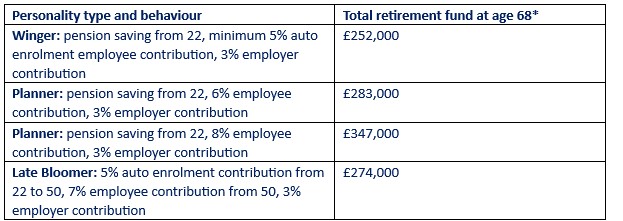
Standard Life analysis shows how these different approaches could add up over a working lifetime. Someone taking a Winger-style approach, sticking to minimum auto-enrolment contributions of 5% from the employee and 3% from their employer throughout their career, could build a retirement pot of around £252,000 by age 68, in today’s prices.
Taking a more Planner-style approach and increasing contributions earlier could make a significant difference over time. Someone starting work at 22 on £30,000 and increasing their employee contribution from 5% to 6% could build around £283,000 by age 68. Increasing this further to 8% could result in around £347,000, adjusted for inflation – £95,000 more than sticking with minimum contributions throughout.
For Late Bloomers, starting to pay closer attention later in life can still make a difference. Someone making minimum contributions from 22, then increasing their contributions by 2% at the age of 50, could build a pot of £274,000 by the age of 68 allowing for inflation.
*Assumptions: Starting salary £30,000, 5% employee and 3% employer monthly contributions, 3.5% annual salary growth, 5% annual investment growth. Figures are reduced to take effect 2% inflation. Annual Management Charge of 0.75% assumed. The figures are an illustration and are not guaranteed. Earning limits not applied.
Emma Furlonger, Managing Director for Workplace Pensions at Standard Life, said: “Most of us can probably recognise a bit of the Winger in ourselves. Retirement can feel a long way off and there are plenty of more immediate demands on our money, so it can be easy to leave a pension ticking away in the background without giving it much thought.
Of course, few people fit neatly into a single pension personality, and many of us will recognise aspects of several of them at different stages of our lives. But understanding the habits and behaviours that influence how we engage with retirement saving can be a helpful reminder to take stock and check whether we're doing enough for our future selves.
“You don’t need to become a pension expert to make a difference. Simply knowing roughly what you’ve saved, checking what you’re paying in and seeing whether you’re on track are all useful places to start. Taking small steps to engage with your financial future today can lead to better outcomes later on. Our analysis shows that increasing contributions by even one percentage point early in your career could add thousands of pounds over time.
“If you're more of a Late Bloomer, the message isn't that you've missed the boat. Everyone's journey to retirement is different, but starting to pay attention today can still make a meaningful difference, and Pension Engagement Season is a good prompt to check in. A few minutes spent looking at your pension today could be something your future self is very glad you did.”
|