|
|




 |  |  |  |
 Moving beyond box-ticking, scenario analysis empowers organizations to anticipate disruption, allocate resources smartly and build lasting resilience. Across industries, leaders face a landscape that is more volatile and interconnected than ever. From cyber-physical convergence to climate extremes, geopolitical fragmentation, and technology-enabled threats, disruption is no longer occasional, it is the baseline. As the materiality continues to add up, internal and external stakeholders are asking sharper questions |
By Lucy Stanbrough, Head of Emerging Risks, Research Network and Jen Daffron,Emerging Risks Research Lead, WTW What are we missing? Where could our assumptions fail? Are we prepared for the next disruption – not just the last? Is our strategy resilient? 80% of respondents to WTW’s Emerging and Interconnected Risks Survey said “no” when they thought about the next 10 years. To answer these questions, leaders are embracing scenarios in their many forms to clarify decisions, challenge comfortable assumptions, test their strategy, inform insurance purchasing, strengthen resilience and improve capital planning. Respondents emphasized the power of scenarios, seen as “more useful than data to determine appropriate responses strategies.” Scenarios are not a new tool but their inherent strengths in adaptability and ability to handle complex interactions make them perfectly suited to respond to three key drivers: 01. The past no longer explains the future
Historical loss experience used to be a reasonably stable guide. Today, it is a partial and, sometimes, misleading indicator. Climate volatility breaks prior patterns. Geopolitics reshapes trade routes overnight. Supply chains behave non-linearly under stress. Cyber risk mutates faster than controls can adjust. Organizations that rely solely on backward-looking data leave themselves dangerously exposed. Enhanced scenario thinking and access to specialized insights will be essential to not just keep pace with this rapid change, but to plan for it and find opportunities.
02. Disruption no longer arrives one risk at a time
The borders between loss events increasingly blur in a complex risk landscape. A climate-driven flood leads to a supply chain breakdown, which triggers margin pressure, which affects credit lines, which shapes insurance recoverability. A cyber incident overlaps with labour shortages. A geopolitical event cascades into commodity price spikes, transport delays and demand volatility. Single-event models do not capture these interactions. Scenarios can be designed to help tell the whole story and bring interconnected risks to life better than single lines on a risk register. Scenario thinking is essential for understanding these interdependencies. By taking a wider, more realistic risk view, you need not continually be surprised by risks.
03. Decisions demand stronger justification
Boards want to know “why this and not that.” Regulators want coherence across capital, operations and disclosures. Insurers want visibility into risk maturity. Retention strategies, insurance tower design, capital buffers, supplier diversification, resilience investment – these are no longer routine operational decisions. They are strategic, scrutinized and often contested. Scenarios contextualize complex risks and provide the shared language that makes complex decisions defensible with a higher resistance to the partialities or bias stakeholders may hold.
With more leaders turning to scenarios for answers, it is essential to challenge what they are and how best to use them. In this insight, we examine: What scenarios really are (and why they’re often misunderstood)
Why scenario thinking has become essential for risk & insurance management
What makes a scenario truly useful
How scenarios are influencing decisions across industries
What scenarios really are (and why they’re often misunderstood)
Many organizations still treat scenarios as administrative exercises: a set of numerical shocks supplied by regulators or auditors. That is a narrow and limiting view.
A scenario, in its proper form, is a structured exploration of a plausible future operating environment. It combines a clear narrative of how conditions change under stress with the data, models and judgement needed to quantify the implications. It shows not just what could happen, but how events evolve when pressure points appear and which decisions matter most under that future. What makes scenarios so powerful in risk analysis is their ability to reveal asymmetries. You often discover that the organization is far more exposed to one type of change than anyone realized – and surprisingly resilient to another. This reframing is often the turning point. Scenarios stop being paperwork and become powerful tools for addressing strategic questions. Among the most common diagnostic, are: “What if...?”: Scenarios can enable exploration of hypothetical situations, such as “What if global energy prices rose sharply?” or “What if a major technology breakthrough disrupted the market?”
“What could happen?”: Scenarios can be focused on identifying a range of plausible developments and outcomes.
“How fast is too fast?”: Many risks are a matter of when, not if. The stress from scenarios can come in the forms of timelines rather than the risk itself, to understand how resilient companies are to volatile markets, legislation changes, and geopolitical events.
“How might we respond?”: By visualizing different futures, scenarios can help decision-makers plan appropriate responses, such as policy adjustments, investment choices, or crisis management plans.
“How can we capitalize on this?”: Instead of rising and falling with a reactive marketplace, proactive decision-makers can find the opportunity side of risks. From quick pivots to reviewing strategic investments, scenarios can illuminate growth pathways and evidence decision making.
These questions promote a mindset of preparedness and adaptability, encouraging organizations to anticipate challenges before they arise instead of reacting after the fact. What makes a scenario truly useful
While scenarios are immensely useful, it’s important to recognize their limitations. Scenarios are tools for thinking, and their value depends on the quality of the assumptions and the creativity of the design process. They are not predictions, nor can they fully capture the complexity and unpredictability of real life. Scenarios are most effective when accompanied by other methods, such as impact quantification, trend analysis, forecasting, or stakeholder analysis. Used in isolation, they can oversimplify or overlook critical nuances.
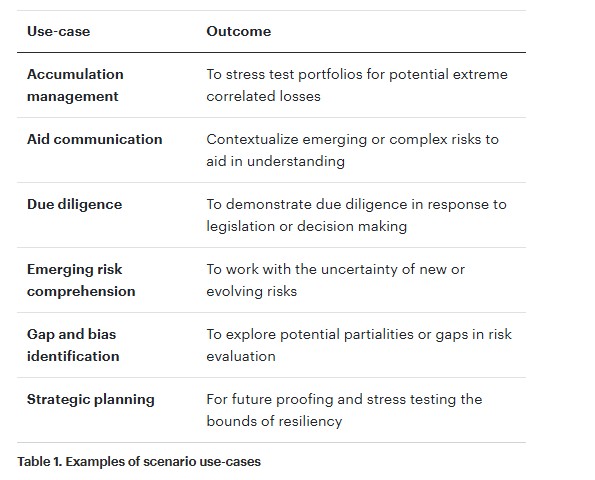
Scenarios can come in many forms. They may present as in-depth reports, executive summaries, slide decks, or risk indices - all with extensive background research, subject matter expertise, and client communication at their cores. The end use determines the design. Each of these pathways may require a different delivery method. Table 1. Examples of scenario use-cases
The strongest scenarios share several qualities: Grounded in clear logic: The narrative and the numbers reinforce one another, showing not only what changes but why it changes and which assumptions shape the result.
Illuminates consequences that matter: Scenarios should focus on cashflow stress, supply chain interruption, accumulation risk, capital strain, customer impact, regulatory breach, and insurance recoverability.
Specific and relatable: Participants should be able to imagine themselves inside the scenario. When executives can “feel” a scenario – sense the tension points, the operational friction, the financial pressure – the conversation shifts from academic to actionable.
Action-oriented: Scenarios should point toward meaningful decisions: how retention should shift, where insurance placement is insufficient, how mitigation investment should be prioritized, or where operating models require redesign.
Iterative and adaptable: Scenarios should be living documents that are updated as new data becomes available with regular review by subject matter experts and clients.
How scenarios are influencing decisions across industries
Across sectors, scenarios are no longer hypothetical discussions – they are steering real strategic choices. The common thread is that scenarios make consequences visible long before they arrive. They allow leaders to act early and intelligently rather than react late under pressure.
Financial services and insurance: Scenarios shape capital allocation, reinsurance structure, risk appetite and underwriting strategy. Leadership teams use them to understand how rapidly their solvency or claims patterns could shift under alternative economic or climate environments, and to defend those decisions internally and externally.
Energy and power: Scenario ranges test whether asset portfolios remain viable under different transition pathways, regulatory conditions or commodity dynamics. They can help uncover when physical resilience or grid dependency becomes the greatest limitation on performance.
Manufacturing and industrial businesses: Scenarios expose supply chain fragility, workforce constraints and technology dependencies. A single scenario – such as the prolonged closure of a key transport route – can materially alter insurance strategy, contract structures and operational design.
Technology, retail and consumer industries: Scenarios help quantify how cyber escalation, sudden consumer shifts or reputational amplification might reshape revenue, operations and uninsured exposures. They highlight where dependency on a single cloud provider or logistics partner could become a point of systemic failure.
Public sector, healthcare and education: Scenarios guide planning under funding uncertainty, demand surges, infrastructure interruptions and workforce disruption.
Closing thought: scenarios are a strategic lens, not a compliance task
Risk and insurance managers are being asked deeper questions than ever before. Scenarios provide the clarity, coherence and foresight required to answer those questions well. They help organizations confront uncomfortable realities early, allocate resources intelligently and build resilience that holds up under real-world complexity.
As you consider your risk and strategy actions for the year, consider where scenarios can add value by stress testing the question you’re looking to answer. “What could happen?” “What if...?” “How fast is too fast?” “How might we respond?” “How can we capitalize on this?” In future articles we’ll explore what types of scenarios to use to answer each and share best practice. We will also be publishing a new series of scenarios to illustrate those best practices.
|
|
|
|
| Qualified Pricing Actuary, Property | ||
| London - £140,000 Per Annum | ||
| Specialty Pricing Actuary (Part time ... | ||
| London - £125,000 Per Annum | ||
| Pricing Actuary | ||
| London - £180,000 Per Annum | ||
| Actuary - Financial Planning & Analysis | ||
| London/Hybrid - Negotiable | ||
| Capital Actuary | ||
| London/Hybrid - £100,000 Per Annum | ||
| Reserving Actuary | ||
| London - £120,000 Per Annum | ||
| Pricing Actuary, Marine Cargo/Property | ||
| London - £130,000 to £150,000 Per Annum | ||
| Pricing Actuary – Cyber | ||
| London - £120,000 Per Annum | ||
| Reinsurance Pricing Actuary, Analytics | ||
| London - £130,000 to £180,000 Per Annum | ||
| Reinsurance Pricing Actuary | ||
| London - £140,000 Per Annum | ||
| Head of Capital | ||
| London - £170,000 Per Annum | ||
| ART Pricing | ||
| London - £100,000 Per Annum | ||
| Pricing Transformation Actuary | ||
| London - £130,000 Per Annum | ||
| Pricing Actuary | ||
| London - £80,000 to £120,000 Per Annum | ||
| Pensions on Divorce Startup - Flexibl... | ||
| Remote - Negotiable | ||
| SVP, Head of Reserve Forecast Analytics | ||
| Bermuda - £200,000 Per Annum | ||
| START-UP, Lead Reinsurance Actuary | ||
| London - Negotiable | ||
| Senior Actuary | ||
| London - Negotiable | ||
| Reserving Manager | ||
| London - £130,000 Per Annum | ||
| Senior Reserving Consultant | ||
| London - £100,000 Per Annum | ||




Be the first to contribute to our definitive actuarial reference forum. Built by actuaries for actuaries.
Copyright © 2026 Actuarial Post. Created by Zero-One Design Ltd