Among the key findings:
31% rank cyber risk – including data privacy failures and external criminal threats – as their top cyber concern, up from 29% in 2025.
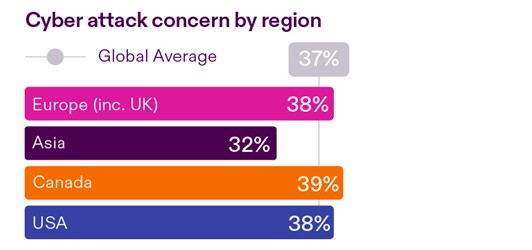
Cyber risk is now a common concern across all major markets, (see chart below).
78% say they are confident their business could fully recover from the financial impact of a cyberattack. However, 33% of global executives also say they plan to invest in stronger cyber security.
82% believe they are prepared for cyber risk, suggesting potential underestimation of a rapidly evolving threat environment.
80% expect AI to boost their bottom line, and 72% expect it to replace jobs in their business over the next 18 months, up from 66% in 2025.
The findings suggest a gap between confidence and reality as cyber risk becomes more systemic. Incidents can spread quickly through shared platforms, suppliers and digital dependencies, meaning resilience is defined less by whether disruption occurs than by how far it spreads, how long it lasts and how quickly a business recovers. And as adoption of AI accelerates, both opportunity and failure move faster, increasing the need to scale controls alongside capability.
Alessandro Lezzi, Group Head of Cyber Risks at Beazley, said: “What stands out in this year’s Risk & Resilience survey findings is a growing misalignment between cyber and tech risk concerns and perceived perception of resilience to these risks. While cyber risk is widely recognised as the number one threat facing businesses globally, 78% believe they could fully recover financially from a cyber attack, demonstrating many organisations are overestimating their preparedness to withstand the full impact an attack across all corners of their operations.
“That gap matters because cyber risk is becoming more systemic – the high profile incidences in 2025 only prove this. As businesses become more interconnected and adopt technologies such as AI, disruption can spread faster across organisations and supply chains making incidents harder to contain.
“It’s encouraging to see however that a third of businesses plan to invest in stronger cyber security, including access to specialist expertise to help them better understand their exposure, strengthen incident response and plan for realistic disruption scenarios across the organisation.”
|











