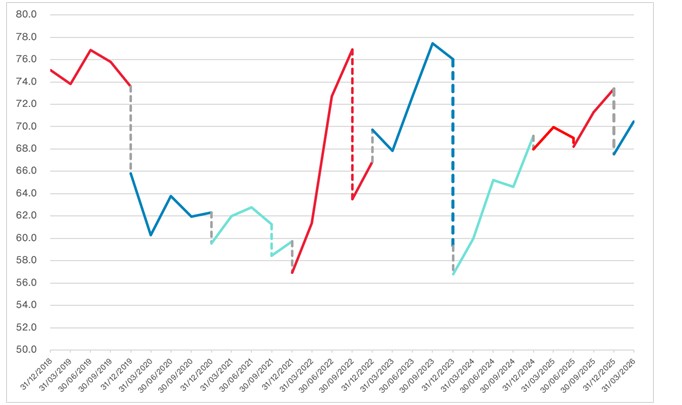
Over the quarter (January to March 2026), the Aon UK DC Pension Tracker rose, which suggests the expected future living standard in retirement provided by defined contribution (DC) savings was higher than at the end of the previous quarter.
Aon DC Tracker
Source: Aon UK DC Pension Tracker (1 January to 31 March 2026)
Note, the sample savers used in the Aon DC Tracker were ’re-set’ to their original age and fund values at the year-end which results in the discontinuity (shown in grey in the chart above) as at 31 December 2025.
The Tracker rose from 67.5 to 70.5 over the first quarter of 2026, driven predominantly by an increase in expected return assumptions pre-retirement and despite negative benchmark investment returns across major asset classes over the quarter.
This has resulted in an increase in expected retirement income for all savers, though younger savers have benefited the most (in percentage terms) from the higher future return assumptions pre-retirement, unlike older members who are closer to retirement.
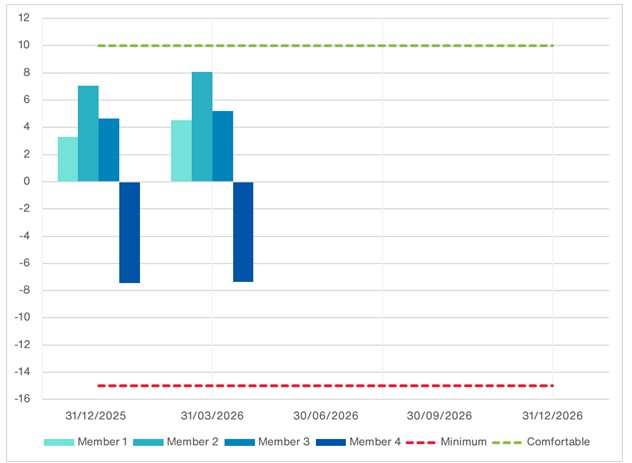
Savers' Positions (measured compared to the ‘moderate' living standard)
Source: Aon UK DC Pension Tracker (1 January 2026 to 31 March 2026).
Second Pension Commission interim report highlights the scale of the adequacy challenge
The publication of the Second Pensions Commission's interim report highlighted the scale of the UK’s adequacy challenge, noting that around 4 in 10 of working age people are currently under-saving for retirement. While the report recognises the success of reforms introduced following the original Pensions Commission, including auto-enrolment and a strengthened State Pension, it makes it clear that significant challenges remain.
Automatic enrolment has been one of the most successful pensions policy reforms of recent decades, transforming workplace pension participation and bringing millions more people into long-term saving. However, for many employees, the statutory minimum contribution level has become the default savings target rather than a starting point, even though evidence shows that current contribution rates are often insufficient to deliver an adequate retirement income.
The Commission also notes that approximately 45 percent of working-age adults – around 18 million people – are not contributing to a pension at all - despite many being in employment. It also expects that 13 percent of the working age population will not meet the Minimum Retirement Living Standard. The report also highlights persistent inequalities in retirement outcomes, with women, carers, the self-employed and some ethnic minority groups facing particular barriers to building adequate retirement savings.
Matthew Arends, partner and head of UK Retirement Policy at Aon, said: "The Second Pensions Commission delivered a clear message. Getting more people saving through auto-enrolment was a major achievement, but participation alone is no longer enough. With millions of people projected to fall short of an adequate retirement income, the focus must now shift towards ensuring people save enough, for long enough, and that they can turn those savings into sustainable retirement incomes. I would hope that the Commission's findings act as a catalyst for employers, pension schemes and policymakers and that they start to address these challenges now, rather than waiting for the final recommendations.”
Latest update to the Pensions UIK Retirement Living Standards released
June saw the latest update to Pensions UK’s Retirement Living Standards - this will be reflected in next quarter’s DC Tracker. The new figures reflect an increase in everyday costs - including food, essential household bills and social activities, which have pushed up the income required across all lifestyles at retirement.
A minimum retirement lifestyle is now up 3.7 percent to £13,900 a year for a one-person household, while a moderate lifestyle costs £32,700 for one person (up 3.2 percent), and a comfortable lifestyle costs £45,400 for one person (up 3.4 percent).
Matthew Arends said: “The latest Retirement Living Standards remind us that the ‘finish line’ for an adequate retirement continues to move as living costs change and expectations evolve. Savers have an important - and difficult - task in understanding their own target and whether their current level of savings can get them there.”
Movement over the first quarter of the year
The increase in the Aon UK DC Pension Tracker over the first quarter of 2026 was primarily driven by an increase in future expected returns pre-retirement over the period. On an individual saver basis, movements over the quarter were positive at all ages.
The youngest saver saw an increase of around £1,500 p.a. (4.3 percent) driven by an increase in expected future investment return assumptions pre-retirement, offset to a degree by negative investment performance over the quarter.
The 40-year-old saver saw the largest increase of around £1,250 p.a. (or 3.1 percent) in their expected retirement income. Again, this was driven by a rise in post-retirement expected future returns. These were also marginally offset to a degree by a reduction in the expected future return post-retirement and by actual investment returns over the period.
Our 50-year-old saver saw an increase of around £650 p.a. (or 1.8 percent) in their expected retirement income. Due to this saver’s larger existing funds, negative performance over the quarter had a larger impact. However, this was offset by increases in expected future return assumptions pre- and post-retirement.
The oldest saver’s income was broadly flat (an increase of around £75 p.a. or 0.3 percent). This was as a result of an increase in expected future returns pre- and post-retirement being almost entirely offset by negative investment return over the quarter.
Overall, the oldest saver is expected to be the worst off in retirement, albeit with a retirement income of around 150 percent of the ‘minimum’ Retirement Living Standard. This excludes any defined benefit pension benefits they may have but which are not included in this projection.
|