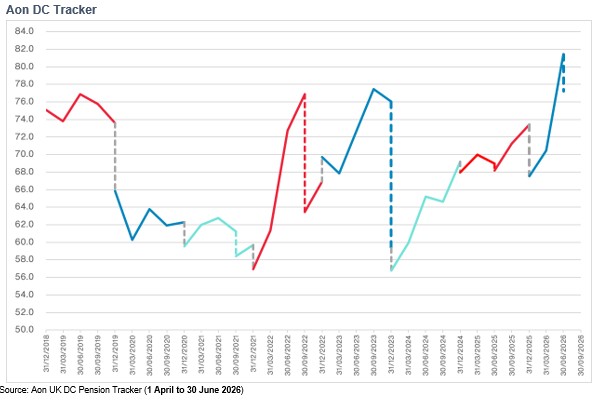
Over the quarter (April to June 2026), the Aon UK DC Pension Tracker rose, which means that the projected future living standard in retirement for workers saving in a defined contribution (DC) pension plan was higher than at the end of the previous quarter.
The grey dashes represent re-setting of the representative members to the example fund values each year and the coloured dashes represent rebases for increases to the Retirement Living Standards.
Overall, the Tracker rose from 70.5 to 77.3 over the second quarter of 2026. There was a significant increase as a result of higher expected future investment returns in the period up to retirement, together with positive actual benchmark investment returns, in particular for equity assets, following the previous volatile quarter. This positive impact was offset to some degree by the June update to the Retirement Living Standards.
Over the quarter, these changes resulted in an increase in expected retirement income for all savers, though younger savers have benefited the most from the higher future returns on investments, compared to older members who are closer to retirement.
Retirement Living Standards have risen, but expected DC outcomes have outpaced these rises
The latest update to the Pensions UK Retirement Living Standards came out in June – with an increase in everyday costs - including food, essential household bills and social activities, pushing up the income required to maintain all lifestyles at retirement.
This rise in the Retirement Living Standards worsened the sample savers’ position in the DC Tracker, as the bar was raised to reach the equivalent Retirement Living Standard. In isolation, the rise in Living Standards reduced the overall tracker by around 4.2 from an otherwise all-time high position. However, April’s increase to the State Pension, alongside strong market performance and a general increase in future investment return assumptions, was more than sufficient to offset these higher targets over the quarter.
The rise in the state pension has been particularly beneficial to savers projected to achieve lower retirement incomes. For a pensioner retiring today, the full State Pension now accounts for over 90% of the minimum retirement living standard.
Volatile market trends continue
Investment markets have remained volatile in 2026 amid geopolitical uncertainty, changing interest-rate
expectations and inflationary pressures. This continues the trend we have seen over the last few years.
While there have been significant short-term fluctuations, the general trend has been positive for pension savers who are typically long-term investors who can ride out some of this volatility.
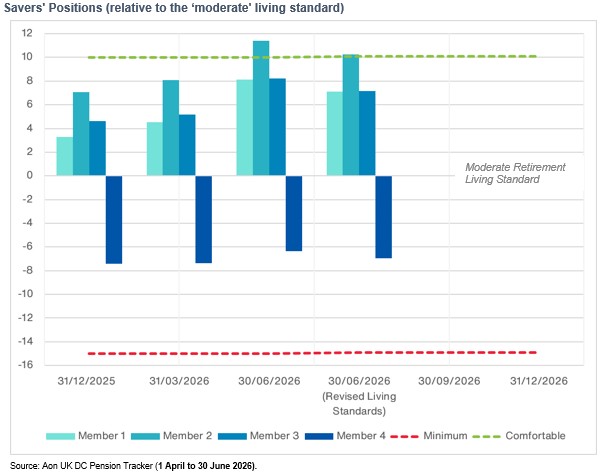
Over the quarter, this volatile investment return has been positive for all savers to varying degrees. The most visible milestone was reached by our 40-year-old saver who - for the first time - is expected to reach the Comfortable’ living standard in retirement. This is despite the recent increase across all Retirement Living Standards having ‘raised the bar’.
While the current near record level of the DC Tracker paints a positive picture for savers, the trends it has shown since it began highlight how market conditions and changes in expectations in retirement can impact expected outcomes. For DC savers, the challenge is navigating this uncertain landscape to ensure they can achieve what an ‘adequate retirement’ means to them.
Steven Leigh, Associate Partner, Aon, said: “The State Pension provides a vital foundation for many savers, but rising Retirement Living Standards mean that many savers may face a significant shortfall when targeting a higher standard of living in retirement. While it is positive that one of our sample savers is for the first time projected to reach the Comfortable Living Standard, volatile market conditions and uncertainty on their retirement age can make planning difficult for savers and many do not know if they are on track for an adequate retirement.
“This is also true of many responsible for running workplace pension arrangements. Aon’s 2026 DC pension and financial wellbeing survey found that 73% of respondents did not know the expected outcome for a typical lifetime member of their DC plan. This adequacy blind spot could ultimately have a detrimental effect on succession planning, employment costs, employee engagement and the commercial success of businesses. There is a real opportunity for those running workplace pensions to get better oversight of expected outcomes for members of their arrangements.”
Movement over the second quarter of 2026
The increase in the Aon UK DC Pension Tracker over the second quarter of 2026 was driven by an increase in future expected returns pre-retirement, together with strong benchmark returns over the period. On an individual saver basis, movements over the quarter were positive at all ages.
The youngest saver saw the largest increase of around £4,400 p.a. (11.9%) driven by an increase in assumptions related to expected future investment return pre-retirement and positive actual investment performance over the quarter.
The 40-year-old saver saw an increase of around £4,050 p.a. (or 9.8%) in their expected retirement income. Again, this was driven by a rise in pre-retirement expected future returns and by actual investment returns over the period.
Our 50-year-old saver saw an increase of around £3,650 p.a. (or 9.6%) in their expected retirement income. Due to this saver’s larger existing funds, positive performance over the quarter had a larger impact for this member. This was also supported by increases in expected future return assumptions pre-retirement.
The oldest saver’s income increased by £1,225 p.a. (or 5.4%). This was as a result of an increase in expected future returns pre-retirement and a positive investment return over the quarter supporting their existing pot.
Overall, the oldest saver is expected to be the worst off in retirement, albeit with a retirement income of around 150% of the ‘minimum’ Retirement Living Standard. This excludes any defined benefit pension benefits they may have but which are not included in this projection.
Our 40-year-old saver is expected to achieve a comfortable living standard for the first time following the increase, with our 30-year-old and 50-year-old savers not far behind at around 90% of the comfortable standard.
|





.jpg)







(2).jpg)