Isio has published its latest analysis of the investment performance and asset allocation of 15 major UK defined contribution (DC) master trust providers. Marking five years since Isio began its peer group comparison series, the latest report highlights how default strategies have evolved significantly, becoming more growth-focused and aligned to how members are now accessing their pensions.
Global equity markets delivered positive returns in the final quarter of 2025, with major indices reaching record levels. UK equities outperformed as investors diversified beyond the US, while emerging markets also generated gains. Credit markets were supported by expectations of further rate cuts, and UK gilt yields fell following the Autumn Budget and easing inflation. Against this supportive backdrop, DC savers continued to benefit from diversified default strategies. However, the more significant story is structural.
Growth phase: greater confidence in long-term return potential
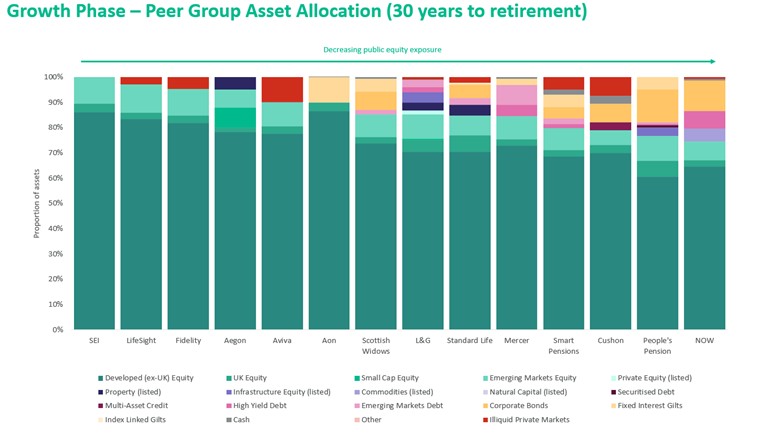
Over the past five years, providers have steadily increased allocations to growth assets within off-the-shelf default strategies. Higher equity exposures across global, regional and small cap markets have become more common, alongside a gradual introduction of private market investments.
This reflects growing confidence that members can tolerate short-term volatility in pursuit of stronger long-term outcomes. Observed behaviour during periods of market stress, including the Covid shock and tariff-driven volatility in 2025, has shown limited evidence of panic-driven disinvestment. That evidence base has supported a more dynamic approach to portfolio construction.
Changes have extended beyond asset mix. ESG integration has become more embedded within default design, with many strategies enhancing sustainability characteristics alongside targeting competitive risk-adjusted returns.
Retirement phase: shifting from annuity mindset to drawdown reality
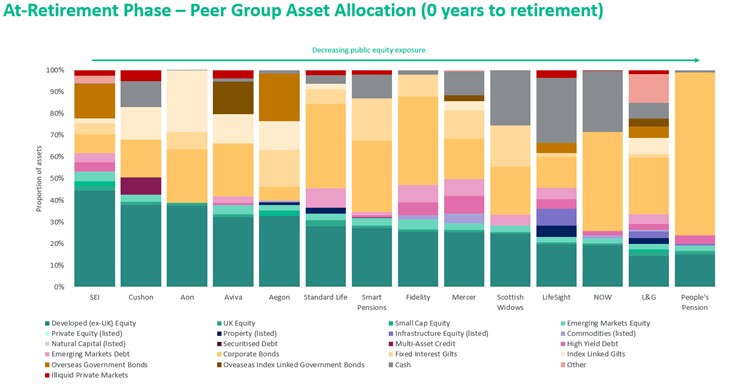
The most notable evolution has taken place at retirement. Five years ago, many providers held between 10% and 30% in equities as members approached retirement, with significant allocations to cash and traditional bonds reflecting an annuity-focused model. Today, average equity exposure in retirement strategies has increased to around 30%, signalling a stronger belief in maintaining growth potential as members transition into drawdown.
Cash allocations have generally reduced as fewer members target full annuity purchase or immediate encashment. With more members opting for flexi-access drawdown, strategies have adapted to support sustainable income over potentially decades of retirement.
At the same time, diversification within fixed income has broadened. Greater use of multi-asset and securitised credit, alongside a shift toward shorter-dated bonds, reflects efforts to manage interest-rate sensitivity while accessing wider sources of yield. Absolute return bond strategies have largely been removed where they have not met expectations.
These developments demonstrate a move away from a predominantly defensive, annuity-led design toward a more flexible, growth-aware retirement framework.
Mark Powley, Head of DC Master Trust Research at Isio, said: “Five years on from our first peer group comparison, the direction of travel is clear. Default strategies have become more growth-focused and more closely aligned to how members are actually using their pensions. Providers have responded to evidence around member behaviour and evolving retirement patterns, increasing equity exposure where appropriate and broadening diversification across credit and private markets. The result is a more balanced approach that seeks to support long-term sustainability as well as short-term stability for DC savers.
“What’s particularly notable is the increased confidence in members’ ability to stay invested through periods of volatility. That has allowed providers to think more strategically about long-term return generation, rather than building portfolios around the fear of short-term market shocks. As retirement behaviours continue to evolve, we expect default design to keep adapting in measured and thoughtful ways.”
|