By Aman Hanspal, Director, WTW
For most clients, wealth must do many things, sometimes more than one at the same time. It needs to preserve capital, support growth, provide income, maintain liquidity, fund lifestyle choices and help plan for succession and legacy. These objectives often overlap and evolve over time. No single product or structure can address them all. That complexity is what makes the institutionalisation of wealth management both important and less predictable than similar shifts elsewhere in the industry.
Wealth combines multiple goals, long time horizons and emotional considerations. Even so, the direction of travel is becoming clearer. A handful of forces are reshaping how wealth firms are built, how portfolios are governed and how outcomes are delivered.
Structural pressures are changing the economics of wealth
Consolidation is one of the most visible signs of this shift. Across the wealth industry, margins are under pressure with profit as a share of AUM already lower by c.19% since 2018 and set to fall further. Meanwhile, regulatory, compliance and operational demands continue to rise. Technology has become a central cost driver, with wealth managers typically investing around 5–10% of revenue in IT. For the largest firms, this translates into multi-billion-dollar annual technology budgets, with global wealth management IT spending reaching approximately $54 billion in 2023 and continuing to grow. In that environment, scale has become less about advantage and more about keeping up. Larger platforms are better able to invest in technology, data infrastructure and regulatory change. They can spread costs across broader client bases and often bring more of the advisory value chain in house. This has accelerated consolidation as firms look to build operating models that are more resilient and sustainable, with PwC estimating that around 16% of asset and wealth management firms could be bought or closed by 2027 as business model pressures intensify. Consolidation is also evolving beyond traditional mergers. Asset managers, insurers, wealth firms and technology providers are increasingly working together through partnerships, acquisitions and distribution-led strategies. As distribution becomes more critical, the boundaries between these sectors are becoming less defined.
Professionalisation is raising the bar on governance
Alongside consolidation sits a broader push towards professionalisation. Multi-family offices offer a clear example. Their growth reflects a shift towards more formal governance and investment processes, with defined committees, multi-asset frameworks and greater exposure to private markets and direct investments becoming more common. At the same time, building a fully institutional-grade platform internally is expensive and complex. For many wealth firms, outsourcing in some way, shape or form has become a practical alternative. OCIO, co-manufacturing and extension of staff investment models all provide different variations for wealth firms to access institutional-quality portfolio construction, reporting and infrastructure in a cost effective, scaled way without the need to replicate the entire function in-house. In many cases, this reflects a conscious choice to strengthen investment and financial outcomes while allowing internal teams to focus on advice, planning and crucially, client relationships.
Operating models are being rebuilt from the inside
Technology is no longer a support function in wealth management; it is becoming the key determinant of scalability and competitiveness. Many wealth firms are reworking legacy systems that have become fragmented over time, particularly as they have consolidated smaller firms through acquisitions but haven’t fully integrated them. Disconnected front, middle and back-office processes are giving way to more integrated platforms designed to improve efficiency and decision-making. Technology is central to this transition. Adoption is already widespread, with most firms scaling AI across multiple use cases to improve efficiency, insight and decision making. Further, Alpha FMC report that 47%–77% of firms are using AI to undertake cost optimisation initiatives, reinforcing that operating model transformation is now a core industry-wide priority rather than an incremental change. Research from the Thinking Ahead Institute’s Global Wealth Study 2025 highlights the challenge this creates. Meeting evolving client expectations remains the top priority for wealth managers, closely followed by the need to expand services, improve efficiency and keep pace with technology, all while scaling operations in a tougher environment (Figure 1). Figure 1: Top business priorities (2-3 years) of wealth managers
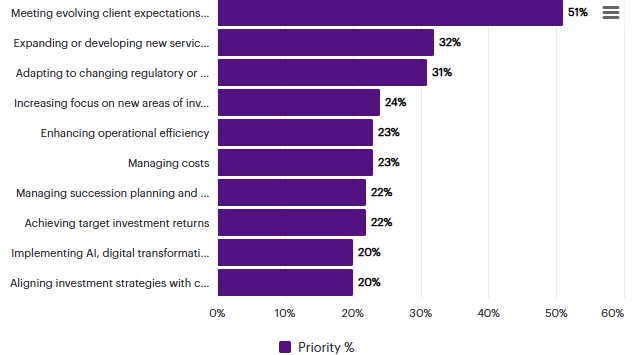
Source: Thinking Ahead Institute, Global Wealth Study 2025
Finding balance as the wealth management industry evolves
One result of these forces has been the rise of larger, multi-asset and multi-channel platforms. At the same time, the market is not converging on a single model. Instead, it is polarising. Large, integrated firms are building scale and breadth, while specialist boutiques compete through focused expertise, clearly defined propositions and strong relationships. Institutionalisation should not be viewed in isolation. It interacts closely with professionalisation and personalisation. While institutional frameworks bring discipline and resilience, long-term success still depends on delivering outcomes that feel relevant to individual clients. The challenge for wealth firms is to combine institutional standards with personal judgement and flexibility. For that reason, institutionalisation is best seen not as a one-off transition, but as an ongoing evolution that will continue to shape who succeeds as the industry evolves ever more rapidly.
|