It highlights a financial reality facing many professional athletes: while their careers may be short, their retirement could last for decades. For those with a limited earning window, investing early in a pension can help turn peak earnings into a lasting retirement income through tax relief and the benefit of decades of compound growth.
While few of us earn our living on Centre Court, the same principle applies more widely. Whether it's a bonus, inheritance, business sale or redundancy payment, investing part of a windfall into a pension early can give those savings decades to grow.
The prize pension ladder
PensionBee modelled how much a 25-year-old Wimbledon player could have at age 67 if they invested their entire 2026 prize money into a personal pension.
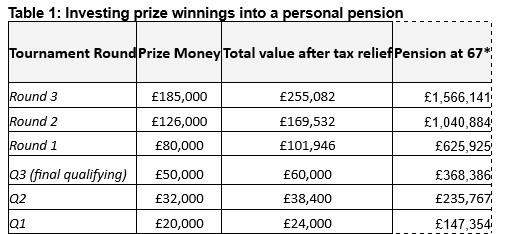
Projections show the value at age 67 of a prize lump sum invested at age 25. Figures assume maximum contributions with full tax relief and annual allowance. Growth is modeled at 7% annually, with a 0.70% management charge and 2% inflation applied to show all values in today's money.
The modelling illustrates a broader principle: when earnings are concentrated in a relatively short period, putting money into a pension early gives it longer to benefit from added tax relief and the power of compound growth.Even a player who exited in the first round of qualifying with £20,000 could build a pension worth £147,354 by retirement - more than seven times the original prize in today's money.
A player who made it to round 1, winning £80,000, could grow that money into a pension pot worth almost £626000. By comparison, an £80,000 lump sum held in cash and growing broadly in line with inflation would still be worth around £80,000 in today's money at age 67. That’s a difference of over half a million pounds.
Maike Currie, VP Personal Finance at PensionBee, commented: “Wimbledon prize money makes eye-watering headlines, but the bigger story is what happens to that money after the tournament ends. While a first-round exit is no doubt disappointing, winnings of £80,000 invested in a pension at age 25 could grow into more than £625,000 by retirement. That's thanks to the combined power of pension tax relief, compounding and time.
“For people who earn much of their lifetime income early in life - whether they're athletes, performers, entrepreneurs or anyone receiving a windfall - the challenge is turning a short period of success into long-term financial security. The temptation is to spend while income is high, but setting some of it aside and giving it decades to grow can make an extraordinary difference later on.
“The lesson isn't just for professional tennis players. Whether it's a bonus, inheritance or other windfall, investing part of it early in a pension can have a much bigger impact on your retirement than many people realise. When it comes to long-term investing, time is the most powerful ingredient. ”
-Ends-
|