From starting a family to becoming self-employed, major life moments can be financial turning points, changing how much people put away for retirement for better or worse, according to research1 from Standard Life, a retirement specialist focused entirely on retirement savings and income.
With Pension Engagement Season underway, Standard Life’s research shows these moments can be a positive catalyst to save more, with one in six (16%) people with a private pension who have experienced a major life event saying they have increased their contributions as a result.
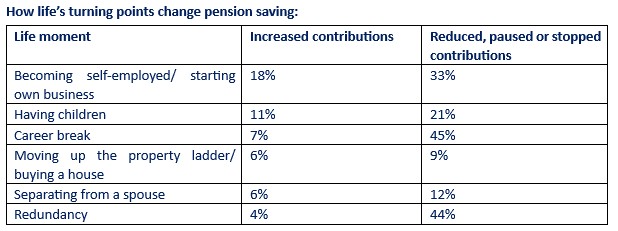
Becoming self-employed is the strongest positive trigger, with almost a fifth (18%) increasing their contributions, while 11% boosted contributions after having children. Other moments prompting people to save more include taking a career break (7%), moving up the property ladder (6%) and separating from a spouse (6%).
But life changes can pull pension saving in the other direction too. More than a third (37%) of people with a private pension say they have reduced, paused or stopped contributions following a major life event. This rises to 45% following a career break, 44% after redundancy, 33% by becoming self-employed, and 21% after having children.
Yet many only check their pension when life changes
Life changes have the potential to reshape pension saving, however separate Standard Life research2 shows many people are relying on these moments to prompt them to check in on their pension altogether. Almost one in five (19%) say they only review their pension following a major life event or financial change, compared with a third (34%) who review it regularly regardless of what is happening in their life.
Among those who don’t review regularly, almost a fifth (17%) say they simply don’t think about their pension unless something changes, while 15% don’t know where to start and 14% don’t think they need to think about their pension at all.
Emma Furlonger, Managing Director for Workplace and Retail Intermediary at Standard Life, said: “It’s understandable that big changes in our lives make us think differently about our finances. Starting a family, becoming self-employed or seeing our circumstances change can naturally prompt us to think about what we’re putting away for the future, and it’s really positive to see that these moments are leading many people to increase their pension contributions as a result.
“Everyone’s journey to and through retirement is different, so there will inevitably be times when people can afford to save more and other times when they need to pull back. The important thing is that changes to pension saving are considered decisions, rather than knee-jerk reactions to what’s happening in life – and this is where regular pension engagement really matters. A major life event can be a helpful reminder to check in, but it shouldn’t take one to get us thinking about our retirement savings. Knowing what you’re contributing and whether you’re on track means you’re better placed to make the most of opportunities to save more, or adjust your plans when circumstances change.”
Emma shares five ways to stay on top of your pension – whether life changes or not:
1. Check whether you’re on track: “Make a habit of checking what you’ve saved, what you and your employer are contributing and what that could mean for your retirement. Your pension provider may have tools or calculators that can help you understand where you stand and whether you might need to make changes.”
2. Make the most of opportunities to save more: “A pay rise, bonus or new job can be a good opportunity to look at what you’re contributing and whether you could afford to put more away. When changing jobs, it’s also worth keeping track of pensions you’ve built up with previous employers.”
3. Think before reducing or pausing contributions: “There may be times when other financial priorities mean you need to reduce or stop contributions. Check what any change could mean for your own and your employer’s payments, and set a point to review the decision so a temporary change doesn’t automatically become a long-term one.”
4. Keep your pension details up to date: “Life changes can mean your pension needs updating too. Check that your contact details are current and review your nominated beneficiaries following changes such as marriage, divorce, having children or bereavement.”
5. Make it easy to stay engaged: “If your provider offers an online account or app, using it can make it easier to check your pension regularly, keep your details up to date and see what you’re contributing. Having easy access to that information can help make pensions part of your normal financial routine.”
|





.jpg)







(2).jpg)