New research from Standard Life and WPI Economics suggests that reforms designed to support greater scale in the workplace pensions market, together with a stronger focus on long-term value, could help improve retirement outcomes. Across three representative saver profiles modelled, pension pots were between 4% and 20% larger at retirement under the proposed investment approach, with the highest uplift modelled for an early-career saver who takes a career break and later returns to work part-time.
The report, From Scale to Impact: A Blueprint for the Future DC Pensions Market, examines how the UK defined contribution (DC) pensions market could evolve over the next decade as consolidation, the Value for Money framework and wider pension reforms reshape workplace pension investment.
While much of the debate about retirement adequacy focuses on contribution levels, the research suggests that investment strategy could also make a meaningful difference. In the modelling, pension pots were between 4% and 20% larger at retirement under a more diversified investment approach that included greater exposure to private market assets.
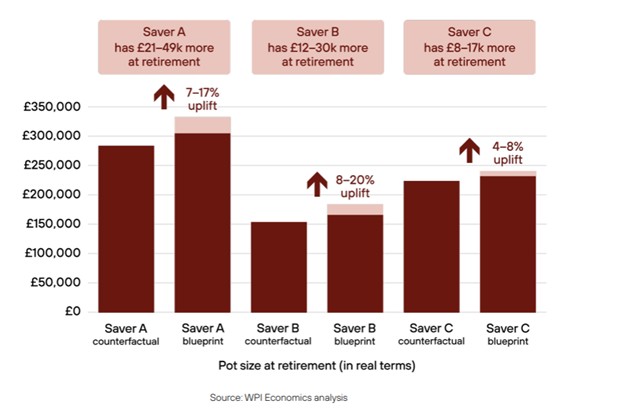
For an early-career saver entering the workforce in 2035 and working full time, this could mean between £21,000 and £49,000 more at retirement. An early-career saver who takes a break before returning to work part time could have between £12,000 and £30,000 more, while a mid-career saver could have between £8,000 and £17,000 more. The potential benefit was greatest when the approach was applied earlier in the savings journey, giving returns more time to compound.
The modelling tested three representative saver profiles: an early-career saver working full-time; an early-career saver taking a career break before returning part-time; and a mid-career saver who had already built a modest pension pot1. Each profile used assumptions about age, earnings, salary growth and pension contributions. WPI Economics ran 20,000 market-performance simulations for each profile to illustrate a range of potential outcomes.
The proposed investment blueprint assumed that 15% to 30% of growth-phase assets were invested in private markets. Outcomes were compared with a counterfactual based on current DC market allocations, which assumed that 1.7% of growth-phase assets were invested in private markets.
Median outcome for pot size at retirement
(net of fees, real terms, 2026 prices)
The findings come amid continuing concern about retirement adequacy in the UK. The report notes that millions of people are not currently saving enough for later life and argues that improving investment outcomes should sit alongside efforts to increase pension saving.
Jenny Holt, Product Director at Standard Life, said: “The pensions industry is rightly focused on helping more people build adequate retirement savings. Increasing participation and contribution levels will remain critically important, but we must also consider how effectively those savings are invested over the long term.
“The reforms under way are expected to create a smaller number of larger pension schemes with greater ability to invest across a wider range of assets. Combined with a stronger focus on long-term value, this could help improve retirement outcomes for millions of savers.
“The debate about retirement adequacy should not only be about how much people save. It should also consider how effectively those savings work for people throughout their careers.”
The report suggests that, by 2035, the workplace DC market could be dominated by 10 to 15 large pension schemes. It argues that greater scale could support broader diversification and increased investment in private markets, subject to appropriate governance, risk management and value for members. A shift from a cost-focused approach to a value-focused framework could also help schemes pursue stronger long-term, risk-adjusted returns for savers.
Joe Ahern, Director of Policy at WPI Economics, said: “The UK faces a significant retirement adequacy challenge, and there is no single solution. Improving investment outcomes will not remove the need for higher pension saving, but our analysis suggests it could make a meaningful contribution.
“Greater diversification and access to a broader range of investment opportunities can benefit savers over the long term. As the pensions market evolves, reforms must remain focused on delivering higher net value for members.”
|





.jpg)







(2).jpg)