British consumers are among the most pessimistic in Europe about their finances in the year ahead, as instability and conflict in the Middle East tops the list of the biggest financial concerns across the continent.
New Europe-wide research from CRIF reveals that half of all European consumers (50%) cite Middle East instability as a key concern affecting their personal finances over the next 12 months.
The conflict has created ongoing disruption to shipping routes and fuel supplies, causing significant global supply chain and energy shocks that are being felt acutely across the UK and Europe.
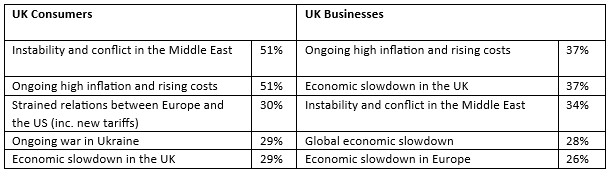
In the UK specifically, the conflict is now joint-top with ongoing high inflation and rising costs (both 51%) as the biggest concern for consumers, and far ahead of other economic and geopolitical issues including the war in Ukraine (29%) and strained relations with the US (30%).
For European businesses, the Middle East conflict ranks as the second biggest threat to their business after rising inflation and costs (39%). In the UK, it ranks as the third biggest threat at 34%, behind inflation and domestic economic slowdown (both 37%) and ahead of concerns over slowdown globally (28%) and in Europe (26%).
Top UK consumer and business concerns
UK consumers now among the most pessimistic in Europe
The research shows British consumers are now among the most downbeat about their personal financial situations. Two in five UK consumers (39%) expect to have less money left at the end of each month over the next 12 months – ahead of the European average of 35%. Reflecting the rising cost of fuel because of the Middle East conflict, one in five (20%) UK consumers are now worried about being able to pay their bills in the next 12 months.
The pressure is also shaping business financial decision making. A third of UK businesses (34%) have already revised their growth plans, a quarter have prioritised cost-efficiency (26%) and even more have paused hiring (28%). On the consumer side, nearly a third (32%) have reduced the amount they put into savings, while 17% have increased their use of credit services like Buy Now, Pay Later.
The role of financial services
While 58% of UK consumers say financial services have a duty to offer affordable products during times of hardship, just a three in ten (30%) think providers are currently doing enough to support financial well-being during uncertain times. UK consumers are also the most likely in Europe to have been turned down for credit, with almost one in ten (8%) having been turned down since January 2025.
Sara Costantini, Regional Director for the UK & Ireland at CRIF, said: "Geopolitical shocks are no longer distant headlines for European households and businesses – they are directly shaping how people spend, borrow and plan for the future.
“In the UK in particular, the picture is downbeat. British consumers are now among the most pessimistic in Europe about their personal finances for the year ahead, with more than half already planning to cut back. Tighter affordability, rising fraud risks and growing uncertainty mean many households and businesses are finding it harder to access the support they need, just as financial pressure is intensifying.
“Financial services remain highly valued, but confidence in delivery is fragile. For banks and lenders, rising credit risk across mortgages, SME lending, and consumer credit is likely to drive more conservative underwriting, lending and investment strategies. The providers best placed to navigate this period will be those that combine stronger, data-led decision-making with a genuinely human understanding of the pressures their customers are facing – ensuring that risk management does not come at the expense of access, trust and financial resilience."
The findings form part of CRIF’s upcoming 2026 Banking on Banks report series. The first report, to be published in June, will look at the biggest financial pressures currently facing European consumers and businesses.
|











