Millions of people could have better retirement prospects if the UK takes the next step in reforming automatic enrolment, according to the Standard Life Centre for the Future of Retirement. This includes lower earners, who could be £30,000 better off in retirement if pension contributions were calculated from the first pound earned, as well as self-employed workers and those with multiple jobs.
While auto-enrolment has transformed pension participation in the UK, bringing millions more people into workplace saving and establishing pension contributions as the default for much of the employed workforce, participation alone is no longer enough. Many people are still saving at levels unlikely to deliver the retirement they expect, and some groups – including lower earners, self-employed workers, and women – are the most likely to feel the current system is not working for them.
According to the Standard Life Centre for the Future of Retirement’s 2026 Standard Life Retirement Voice report, two fifths (42%) of people yet to retire expect their standard of living to worsen in retirement, increasing from a third (33%) in 2024. Furthermore, almost two thirds (63%) of people are worried they are not saving enough for retirement, and almost half (45%) expect their standard of living in retirement to be worse than their parents', up from 39% in 2025 and 33% in 2024.
Lower earners and the self-employed are least confident in the system – and could have most to gain from reform
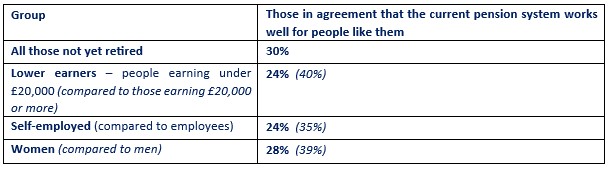
The Retirement Voice findings show that confidence is weakest among many of the same groups identified by the Pensions Commission’s interim report3 as facing particular retirement saving challenges, including lower earners, the self-employed and women. Just 24% of lower earners agree the pensions system works well for people like them, compared to 40% of those earning above £20,000. Confidence is similarly low among the self-employed, at 24% compared to 35% of employees, and among women, at 28% compared to 39% of men.
Impact of calculating pension contributions from the first pound earned
For lower earners, the way auto-enrolment contributions are calculated can make a significant difference over time. Standard Life modelled someone starting pension saving at age 22 on a salary of £18,000, with pay rising in line with inflation so their earnings remain broadly equivalent to £18,000 in today’s prices, and contributing at the current minimum auto-enrolment level of 8% in total, made up of 3% employer and 5% employee contributions.
Under the current qualifying earnings basis, where minimum pension contributions are calculated only on earnings above the Lower Earnings Limit, that worker could build a pension pot worth around £83,000 by age 68, in today’s prices. If contributions were instead calculated from the first pound earned, the same worker could build a pot worth around £113,0001. That means a lower earner could be around £30,000 better off in retirement, under Standard Life’s illustrative assumptions.
Catherine Foot, Director of the Standard Life Centre for the Future of Retirement, commented: “Confidence in retirement remains fragile, particularly among groups such as women, lower earners and the self-employed, who are less likely to feel the current system works well for them. The Pensions Commission has an important opportunity to consider how automatic enrolment can build on its strong foundations and better support a system that is adequate, fair and sustainable over the long term.
“Auto-enrolment has been one of the great pension policy successes of recent decades, but the challenge now is whether it enables people to save enough, early enough, and in a way that reflects different employment patterns and income levels. Lower starting ages, contributions from the first pound earned and support for those currently outside or on the edges of automatic enrolment could make a meaningful difference, particularly for lower-paid workers and people with multiple jobs.
“However, reform must be carefully designed. The timing, sequencing and sharing of any future increases in contributions matter, particularly given the impact on employers and lower earners’ take-home pay. The Commission’s recommendations should therefore set out a clear and gradual path for change, while also considering how the system can evolve to better support self-employed workers, who face a different challenge because they do not benefit from automatic enrolment.”
|