A scheme’s s179 liabilities represent, broadly speaking, the premium that would have to be paid to an insurance company to take on the payment of PPF levels of compensation. This compensation may be lower than full scheme benefits.
Shalin Bhagwan, PPF Chief Actuary, said: “Market conditions remained challenging through the month as persistent inflation pressures and elevated energy prices kept global bond yields high. Expectations of further central bank tightening continued to build, with UK gilt yields rising as investors reassessed the path of monetary policy. Against this backdrop, risk asset performance was mixed and bond markets remained under pressure.
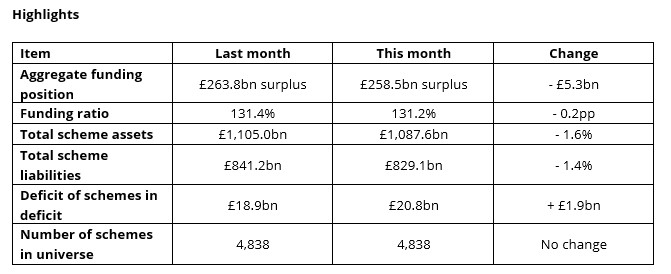
Within this environment, the PPF 7800 index recorded a £5.3bn fall in the aggregate funding surplus, taking it to £258.5bn. The funding ratio dipped to 131.2 per cent, as scheme assets fell by 1.6 per cent and liabilities by 1.4 per cent. Despite the modest softening, funding levels remain robust, supported by the continued influence of higher discount rates.”
A note on changes to the PPF 7800 Index
In our December 2025 update, we highlighted that the government had announced that it would legislate to allow us to pay prospective indexation starting from 2027 for service accrued pre-1997 for members of schemes who provided this as a right. As well as schemes that have already transferred to the PPF, this will also impact the s179 liabilities of schemes in the PPF universe. In April the Pension Schemes Act received Royal Assent. As we’ve signposted, we’ll reflect the impact from these changes in the PPF 7800 Index in due course.
View the May update and see the supporting data on the 7800 Index for 30 April 2026 here: The PPF 7800 index | Pension Protection Fund.
|











