The Retirement Expectation Gap – the difference between when people want to retire and when they expect to be able to – has broken the five-year barrier for the first time, according to new research from the retirement specialist Standard Life.
The report highlights a growing divide between people’s retirement aspirations and expectations, against the backdrop of a rising State Pension age and continued financial uncertainty. People still want to retire at 62.3 – an age that has remained unchanged for three years – but the age at which they expect to actually stop working has risen again and now stands at 67.6. This has widened the gap between retirement hopes and expectations to 5.3 years, up from 4.7 last year and 4.4 in 2024.
Why the Retirement Expectation Gap might be growing
The widening gap comes as people continue to navigate financial pressures and concerns about whether they have saved enough for later life. More than a quarter (26%) of UK adults are struggling to get by on their current income, slightly up from 24% last year, while two in three (63%) worry they are not saving enough for retirement. Almost half (48%) also say their retirement finances are mainly influenced by factors outside of their control.
However, the research also suggests that the gap is far from fixed. Standard Life analysis finds a strong relationship between financial planning and retirement expectations, with those who have done the most planning facing a gap 4.8 years smaller than those who have done none.
Millennials and Gen Z face the biggest Retirement Expectation Gap
While the average Retirement Expectation Gap is now 5.3 years, it varies sharply across the UK with different groups facing different retirement realities. Women, renters, younger generations, and those living in the North East face some of the widest gaps – all of which have widened over the past year:
Renters vs homeowners: Renters face a retirement gap of 6.8 years, increasing by 0.7 years in just 12 months. This is more than three times the 2.1-year gap among those who own their home outright and more than a year longer than the 5.7-year gap for mortgage holders.
Growing gender gap: Women’s retirement gap has widened from 5.4 years in 2025 to 6.1 years today, while men’s has increased from 4.1 to 4.5 years. This means women now face a retirement gap almost 40% larger.
Younger generations face the largest gaps: Millennials and Gen Z face retirement gaps of 6.8 years and 5.9 years respectively, the largest of any generation, and want to retire earliest at 61 and 60 respectively.
The regional divide: The North East has the widest regional retirement gap at 6.6 years, while Greater London has the narrowest at 3.8 years. The East Midlands (6.2 years), Wales (6.1 years) and South East (6.0 years) also have gaps of six years or more.
Working longer may not be realistic for everyone
The data suggests that people are not only concerned that their ideal retirement age is slipping further away, but that working longer may not always be an option. While 51% expect they will need to work beyond State Pension age, almost one in five (18%) say they would be unable to continue in their current role past 60, and almost half (47%) say they could not continue working in the same role beyond 70.
Pessimism about life after work is also growing, with over half (51%) worrying whether their finances will last throughout retirement and two-fifths (42%) expecting their standard of living in retirement to be worse than it is today.
Yet despite these fears, just 12% of people are prioritising pension saving – down from 15% last year – and more than a third (35%) have done no retirement planning whatsoever, rising to 39% of millennials and 40% of Gen Z – the two age groups that want to retire the earliest.
Those who plan more have a narrower gap – even on the lowest incomes
Standard Life’s analysis shows a clear relationship between retirement planning and the Retirement Expectation Gap. Those who have done ‘a great deal’ of retirement planning have a gap of just 2.5 years, compared with 7.3 years among those who have done none.
Even among those on the lowest household incomes (under £30,000), people who have engaged in financial planning expect to retire 1.6 years earlier than those who have done none, and more than two years earlier than non-planners earning £30,000 - £100,000. Among the highest earners (over £100,000), those who have planned have a gap of just 0.6 years, compared with 5.1 years among those who have not.
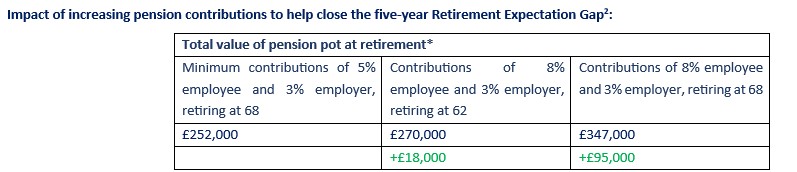
Starting early can also make a significant difference. Someone who starts work at 22 on a salary of £30,000 and pays minimum auto-enrolment contributions (5% employee, 3% employer) could build a £252,000 pension pot by 68 in today’s prices. However, increasing contributions by three percentage points could allow them to retire at 62 – their preferred retirement age – with a slightly larger £270,000 pot, allowing for inflation. While this could help bring retirement plans closer to reality, retiring earlier also means potentially funding a longer retirement and bridging the gap until State Pension income starts, making forward planning all the more important.
*Assuming 3.50% salary growth per year, and 5% a year investment growth. Figures account for 2% inflation. Annual Management Charge of 0.75% assumed. The figures are an illustration and are not guaranteed. Earning limits not applied. Pensions can go down as well as up and are not guaranteed.
Catherine Foot, Director of the Standard Life Centre for the Future of Retirement, commented: “This year’s Retirement Voice findings point to a noticeable shift in how people are feeling about retirement. The age people would ideally like to retire hasn’t changed, but the point at which they think they will actually be able to stop work is drifting further away. That is happening as the State Pension age itself begins its phased rise from 66 to 67, and against a backdrop of renewed pressure on household finances and a wider sense of economic and global uncertainty. Together, these factors risk making retirement feel less certain and more distant, rather than a milestone people can plan towards with confidence.
“The gaps matter too. Renters, women and younger generations, as well as those living in the North East, are among those furthest from the retirement they would ideally like, while many people also question whether working into their late 60s or beyond will be physically or practically possible. As the State Pension age rises, that should be an important consideration for policymakers. A sustainable retirement system cannot simply assume that everyone will be able to solve an adequacy problem by working for longer.
“There is, however, a positive message for individuals. The findings show a very clear relationship between planning and people’s retirement expectations, even among those on lower incomes. Starting earlier, understanding what you already have and, where affordable, increasing pension contributions can make a meaningful difference. For many people, relatively modest action now could help bring the retirement they want considerably closer.
“At the same time, individual action can only go so far, and this report underlines the scale of the opportunity presented by the next stage of the Pensions Commission to shape the adequacy of pension saving and consider the long-term future of the UK’s pension system. Employers also need to consider how careers can become more flexible as working lives lengthen. The goal should be a system that gives people greater confidence and is fair to the people who live with it, giving them choice over when and how they retire, rather than having a later retirement as the default because they feel they have no alternative.”
|