Retired households with the lowest incomes receive a lower value of cash benefits than better off counterparts, official data shows.
Retirement specialist Just Group said the figures are a reminder that pensioners struggling on low incomes should doublecheck their entitlement to key benefits such as Pension Credit which is only claimed by about two-thirds of those eligible.
The analysis of recently published ONS data for 2023/24 splits retirees into five groups (quintiles), covering the lowest annual income pensioner households – group 1 – to those who have the greatest income – group 5.
This data found that the lowest income retirees received £11,327 a year on average in direct cash benefits including State Pension. That is £5,994 a year less than the top income group (group 5) whose gross annual income (£68,561) was nearly five-times higher than the lowest-income pensioners (£15,003).
[Text Box: Benefit Income (£)] [Text Box: Gross income (£)] The biggest disparity in the amount of cash benefits and State Pension received was between group 1 (those with the lowest gross income) and groups 3 and 4 who received an extra £7,754 and £7,743 respectively.
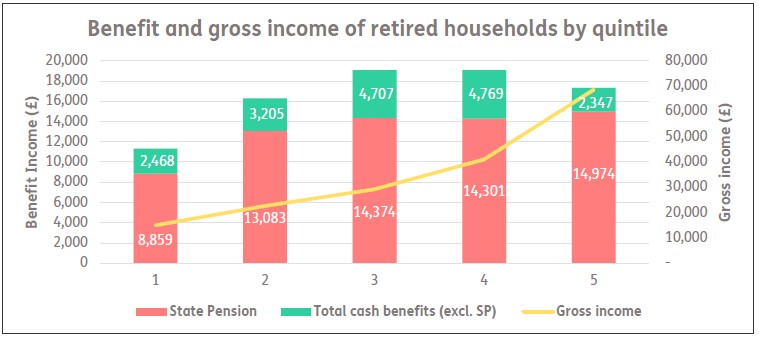
Looking at this as weekly income, shows that those with highest annual household income receive £100 more a week in cash benefits and State Pension than those with the least income. This rises to nearly £150 a week more for the middle income bracket – groups three and four – which see the greatest disparity in annual cash benefits and State Pension compared to the lowest group.
The data also showed that the bottom income quintile received considerably less in State Pension (£8,859) than those on higher incomes (£14,974). This group also received a lower amount of Pension Credit, the benefit specifically designed to support lower income pensioners. Group 4 received £454 a year on average, while group 1 received an average of £285.
Recent Department for Work and Pensions government figures show that up to £2.5 billion of Pension Credit goes unclaimed each year, with almost a million pensioner households missing out on £2,600 a year on average. Take-up of Pension Credit varies from 55% of those eligible in the South West to 69% in London.
Just Group’s annual State Benefits survey4 discovered that over a third (35%) of adults aged 66 and above said they had never checked their eligibility for State Benefits.
Stephen Lowe, group communications director at Just Group, said: “These findings challenge the idea that the lowest income pensioner households get the most in State Benefits. In fact it is middle income pensioner households that receive the biggest amount.
“In some cases this is because people don’t realise what benefits they can claim or assume they won’t qualify, perhaps because they own their home. Others may get less because they haven’t built up enough qualifying years of National Insurance or have missed out on extra entitlements.
“While last week’s Autumn Budget confirmed a further State Pension uprating – worth an extra £575 next year for those on the full new State Pension – many older people still face a shortfall in meeting day-to-day costs. That’s why it’s still so important that pensioners check what additional support they may be eligible for. Even a small boost in income can make a meaningful difference.”
|











