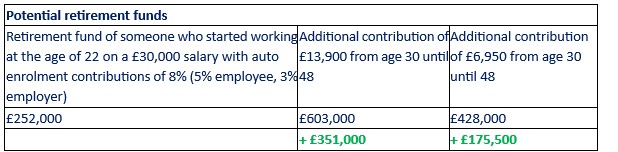
As summer draws to a close and many families take stock of the cost of the summer holidays and back-to-school spending, new analysis from the retirement specialist Standard Life suggests that some dual-income households without children, often referred to as 'DINKs' (Dual Income, No Kids), could build an additional £351,000 in retirement savings by directing the equivalent cost of raising a child into their pension.
This analysis comes as family patterns continue to evolve, with the fertility rate in England and Wales falling to 1.39 children per woman in 20251. For DINK households, lower child-related spending can mean greater flexibility in how disposable income is allocated, creating opportunities to prioritise longer-term financial goals such as retirement saving.
What if the cost of raising a child went into a pension instead?
To illustrate the long-term impact, Standard Life compared the average estimated cost of raising a child, around £250,000 by age 18.² Spread evenly across 18 years, this equates to approximately £13,900 a year. Standard Life calculations show that someone who contributed an additional £13,900 to their pension each year for 18 years from the age of 30 could build a pension pot worth approximately £603,000 in today's prices by age 68.³
This is around £351,000 more than someone who also started saving at age 22 on a salary of £30,000 a year and contributed only the minimum auto-enrolment amounts (5% employee and 3% employer contributions) throughout their working life, but did not make any additional contributions from age 30.
Even contributing half this amount (£6,950 a year) could make a significant difference. Standard Life calculations show this could add £175,500 to a retirement fund in today's prices, resulting in a total savings pot of approximately £428,000 by age 68, allowing for inflation.
*assuming 3.50% salary growth per year, and 5% a year investment growth. Figures allow for 2% inflation. Annual Management Charge of 0.75% assumed. The figures are an illustration and are not guaranteed. Earning limits not applied.
Emma Furlonger, Managing Director for Workplace Pensions at Standard Life, said: “September can be a useful time to take stock of your finances. The summer holidays are over, routines are settling back in, and many people will be thinking again about what they are spending, saving and putting aside for the future.
“For people without child-related costs, there may be periods when there is a little more flexibility in the household budget. It might not be realistic to put the full equivalent cost of raising a child into their pension every year, but these figures show just how powerful additional saving can be when you give it time to grow.
“It doesn’t have to be all or nothing either. Whether you have children or not, putting a bit more away when you can, perhaps after a pay rise, once a debt has been cleared or simply at a point when you have more disposable income, can make a meaningful difference over the course of your working life, helping to build greater financial security in later life. The key is finding a balance that lets you enjoy your money today while making sure some of it is working for your future too.”
|