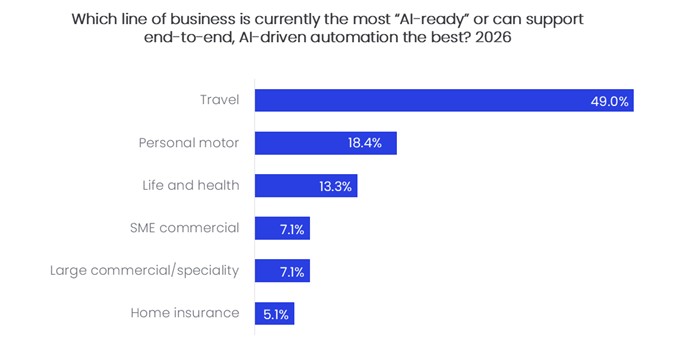
According to a poll* conducted by GlobalData on Verdict Media sites in Q3 2026, nearly half of insurance professionals view travel insurance as the line most ready for end-to-end, AI-driven automation. Personal motor lags far behind in second place, attaining 18.4% of responses.
Beatriz Benito, Lead Insurance Analyst, GlobalData, comments: “Travel insurance policies are standardized, low-value, and often short-term. This standardization makes it easier to implement AI automation. Furthermore, claims are reliant on objective, easily verifiable digital data such as flight delays, cancellations, weather reports, and medical receipts. As such, AI can be used in the end-to-end process—from underwriting to claim payout—without human intervention.”
In a step in this direction, Staysure has deployed an AI chatbot assistant for handling customer queries online, freeing human agents for complex queries.
Benito continues: “Parametric insurance already provides a successful commercial example of how travel insurance can be automated and claims paid without human intervention, with Blink Parametric a renowned company in this space. These simple policies provide a payout if a certain rule or threshold is met, such as if a specific flight is delayed by more than three hours, for example. Such policies pay out automatically if the threshold is exceeded, without the need to file a claim.”
However, true end-to-end AI automation would also need to provide dynamic pricing and underwriting, based on analyzing historic data such as airline reliability or geopolitical impact, as well as being able to detect fraud.
Benito concludes: “While personal motor insurance policies can also be rather standardized and vehicle damage claims can be accounted for by photo-based assessments, more complex claims involving bodily injury continue to require loss adjusters. This will limit end-to-end automation when severe claims are involved.
“Overall, insurance professionals agree that the simpler, more standardized, and lower severity lines are the ones that will be easiest to fully automate with AI. In contrast, complex commercial risks require more bespoke underwriting, often negotiated through brokers, which will take more time to be fully AI-ready.”
|