Insurance-funded private health admissions hit a fourth record year in a row in 2025 - a period when NHS waiting lists for hospital treatment fell to lowest level in three years - according to the latest analysis of PHIN and NHS England data from Broadstone.
There were over two-thirds of a million (670,000) admissions funded by Private Medical Insurance (PMI) through 2025, the highest level ever recorded and 5,000 more than 2024 (665,000) - marking the fifth consecutive year of growth.
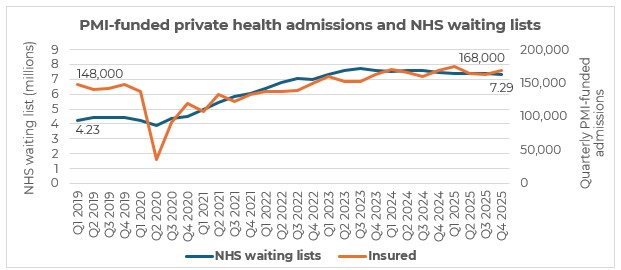
This was in part thanks to a record Q1, which saw the highest quarter ever of 175,000 PMI funded admissions, exceeding the previous record quarter of 170,000 in Q1 2024 by a significant 5,000 admissions. Q3 and Q4 2025 - 162,000 and 168,000 respectively - were also higher than 2024 levels.
PMI-funded admissions have risen by almost a fifth (16%) since pre-pandemic levels, when 579,000 PMI-funded admissions were registered in 2019.
Year on year growth in PMI-funded admissions has fallen from 31% in 2021, 14% in 2022, 11% in 2023 and 6% in 2024, to a mere 0.8% in 2025. As insured admissions are a key driver of overall admissions growth, this has also been reflected in total private admissions, with the rate of year on year growth falling from 45% in 2021 to just 0.6% in 2025.
Meanwhile, NHS waiting lists fell by 137,000 over 2025 to 7.29 million in December, hitting the lowest level in just under three years (February 2023 – 7.22 million). The first three months of 2026 have seen the NHS backlog for hospital treatment fall further, reducing to 7.11 million in March 2026 – the lowest level since August 2022.
There are concerns however that progress in reducing the waiting list for hospital treatment may be a ‘false dawn’, as data shows an increase in the waiting list for diagnostic tests. A record 1.92 million patients3 are now waiting for a diagnostic test in England, suggesting that progress in reducing the headline waiting list may be masking pressures that are building up elsewhere in the system.
“The slowing rate of growth reflects the normalisation of PMI-funded admissions following the post-pandemic surge, and signals that claims inflation is beginning to cool. This will come as welcome news to employers who have seen PMI costs increase in recent years due to high claims costs.”, said Brett Hill, Head of Health & Protection at Broadstone.
“Demand for workplace health benefits remains very much ‘on the up’ however, and we’re seeing this on the ground as employers continue to deploy PMI and other health benefits as part of a strategy to support workplace health and reduce sickness absence.
“While the fall in the headline numbers for NHS waiting lists is welcome news it masks a more complex reality for many patients, with the waiting list for diagnostic tests having increased, and with many employees struggling to access treatment for conditions that commonly keep people off work, such as MSK and mental health conditions.
“With the Keep Britain Working Review endorsing the role of businesses in fighting the UK’s economic inactivity crisis, and cooling claims inflation easing pressure on premiums at renewal, it looks likely that we will soon breach 1 million private treatments every year as businesses fill the UK’s healthcare gap with innovative PMI schemes.”
|