As Burnham hits the road for much of August, UK households face a far from settled economic backdrop. July inflation rose to 2.9%, retail sales fell 0.5% and government borrowing hit £1.8 billion - £2.3 billion above forecast. Meanwhile, geopolitical tensions and oil above $93 a barrel are adding to concerns about inflation and interest rates.
Maike Currie, VP Personal Finance at PensionBee, comments: “For pension savers, what happens in the economy and financial markets matters because your pension doesn’t sit in a vault waiting for retirement - it is invested. Millions of workplace and personal pensions hold a mix of shares, bonds and other assets, so when markets move, pension values can move with them. While that can be unsettling in the short-term, volatility is part and parcel of investing. The long-term nature of pensions allows for volatility to be smoothed and your investment to grow.”
With Burnham championing an economic philosophy he calls “Manchesterism” - described as “business-friendly socialism” and Chancellor John Healey’s first Budget due on 28 October, investors are watching closely. Rising inflation, concerns about government borrowing and volatility in global bond markets have put the new Government’s fiscal plans firmly in the spotlight.
So will Andy Burnham be bad for the stock market – and therefore impact for your pension savings?
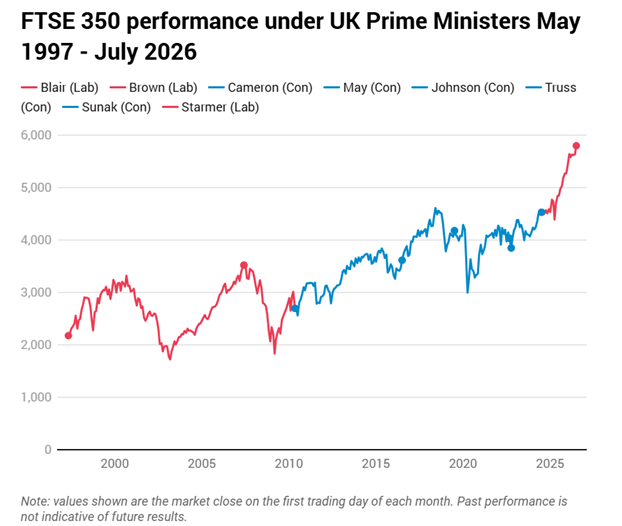
PensionBee analysis of the FTSE 350 - representing 350 of the UK's largest listed companies - looked at its performance from Tony Blair's election in May 1997 to July 2026, shortly before Burnham entered Downing Street.
During that period Britain had eight Prime Ministers: three Labour and five Conservative. Despite changing political parties at the helm, political crises, recessions, wars, a global financial crisis and a pandemic, the overriding direction of the UK stock market over the period was upwards.
There were, of course, dramatic falls. Gordon Brown’s premiership coincided with the global financial crisis. Boris Johnson was in Downing Street when Covid-19 sent global markets plunging. Tony Blair’s time in office encompassed both the dot-com bubble and subsequent crash.
Those episodes demonstrate the danger of attributing stock market performance simply to the politician occupying No 10.
Even Liz Truss’s disastrous 2022 Mini-Budget, which sent the pound tumbling and triggered turmoil in UK government bond markets, had a much less dramatic long-term impact on the UK stock market.
Maike Currie, VP Personal Finance at PensionBee, comments: “Prime Ministers come and go, but your pension will be invested for decades. It’s important to remember that pensions are generally invested globally and across multiple asset classes, so returns can be influenced by everything from US interest rates and technology stocks to oil prices, wars and the wider global political and economic landscape.
“Politics can move markets in the short term, but for pension savers, the bigger risk can be letting short-term political noise derail a long-term investment plan.”
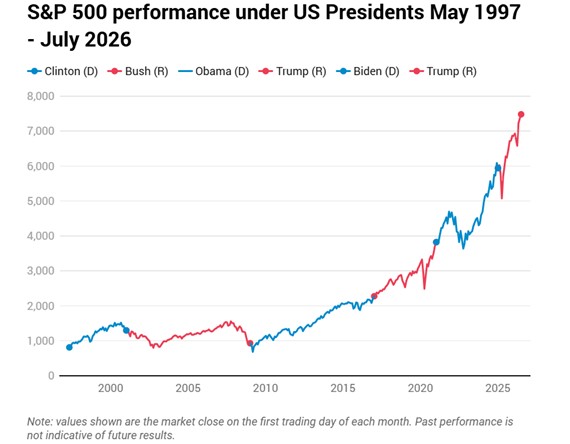
PensionBee’s analysis of the S&P 500 over a similar period covers Democratic and Republican presidents including Bill Clinton, George W. Bush, Barack Obama, Donald Trump and Joe Biden.
Again, there were substantial crashes and periods of volatility, but the long-term direction was upwards - regardless of which party occupied the White House.
Maike Currie, VP Personal Finance at PensionBee, comments: “From AI bubble fears and conflict in the Middle East to higher oil prices, inflation and mounting government debt, there is plenty for investors to worry about. Markets can and do fall, but the bigger danger is turning short-term volatility into a long-term mistake.
“Your pension may navigate several Prime Ministers, Budgets, recessions and market crashes before you come to retire. The lesson from nearly 30 years of market history is simple: your pension is likely to outlast the politicians making the headlines.”
Five things pension savers can do when markets wobble
1. Stay diversified
Spread your pension across different geographies, sectors and asset classes so you’re not overly reliant on one market, economy or group of companies.
2. Keep calm and keep contributing
If retirement is still years away, avoid knee-jerk decisions when markets fall. Continuing regular contributions means you will also buy more investments when prices are lower, potentially benefiting when markets recover. Pension tax relief can give contributions an additional boost even before investment returns are considered.
3. Check your risk as retirement approaches
The closer you are to retirement, the less time you may have to recover from a market fall. Review how much investment risk you’re taking and whether it still suits when and how you plan to access your pension.
4. Give yourself a retirement buffer
If you’re already drawing an income, avoid selling investments at depressed prices where possible. Holding an appropriate cash or lower-risk buffer, or drawing from other available income or assets instead, can give your investments time to recover.
5. Remember that downturns don’t last forever
Historically, rising markets have tended to last longer than falling ones, although there are no guarantees. Staying invested means you remain positioned to benefit from a recovery.
More on how market volatility can shape your pension pot in this bonus episode of PensionBee’s PensionConfident Podcast
|